Sunday, November 14, 2010

Haiti: Cholera Killed Over 900 People -Hundreds Deceased Names Remain in the Electoral Lists

By Wadner Pierre

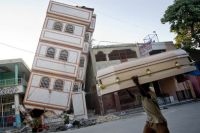
Haiti prepares to hold controversial elections, natural disasters and disease may force the Haitians authorities to reschedule the Presidential and Legislative Elections. On January 12, 2010, a 7.0 magnitude earthquake hit the western and southern parts of Haiti. Over 300,000 people perished, and more than a million were left homeless. This tragedy brought the world together to help Haiti in our time of need. Ordinary citizens from all over the world sent their US dollars and Euros etc, to aid Haitians.


Unfortunately, as it is always been, the money was mostly used to pay for the UN and major NGOs’ bureaucracies, instead of helping the victims of the earthquake. Haiti’s “allies” met and promised several billions of dollars for the reconstruction of the country. Ten months later, the majority of earthquake’s survivors continue to live under makeshift tents and tarps. In the middle of this tragedy combined with empty promises, Haitians have kept their hope alive, and will be forever united. Haitians continue to support each other in any way they can. The world has praised Haitians’ courage. Though the Haitian government shows its incapacity to govern the country, Haitians remain faithful to Haiti’s noble democratic heritage and are eager to vote to choose their leaders in fair, free, inclusive and democratic Presidential and Legislative Elections.

Saturday, November 13, 2010

President Jean-Bertrand Aristide, "Selections Not Elections"

Exclusive Interview with Former Haitian President Jean-Bertrand Aristide

Interview with Nicolas Rossier – November 2010

Currently in forced-exile in South Africa, former Haitian President Jean-Bertrand Aristide is still the national leader of Fanmi Lavalas – one of Haiti's most popular political parties. A former priest and proponent of liberation theology, he served as Haiti's first democratically elected president in 1990 before he was ousted in a CIA backed coup in September 1991. He returned to power in 1994 with the help of the Clinton administration and finished his term. He was elected again seven years later, only to be ousted in a coup in February 2004. The coup was lead by former Haitian soldiers in tandem with members of the opposition. Aristide has repeatedly claimed since, that he was forced to resign at gunpoint by members of the US Embassy. US officials have claimed that he decided to resign freely following the violent uprising. He now lives in exile in South Africa where he still waits to get his diplomatic passport renewed. He is not allowed to travel outside South Africa.

Tuesday, October 26, 2010

Haiti’s Faithless Elections: Lack of Certainty of the Provisional Electoral Council Pushes National and International Leaders to

By Wadner Pierre 

First published by Louisiana Justice Institute 

On November 28, Haitian voters are supposedly going to vote to choose a President, 10 Senators and 99 members of parliament. These general elections, as many politicians and experts expressed, are crucial for Haiti’s political future, and for the rebuilding process on the aftermath of the Jan. 12 7.0 magnitude earthquake. The uncertainty that plagues over these elections can comprise the legitimacy of the elected President, Representatives and Senators from these forthcoming elections.

Tuesday, October 19, 2010

Haiti’s Flawed Elections: A Set-Back for the Country’s Political Future-and the Post-Earthquake Rebuilding Process

Photo courtesy of Wadner Pierre
First published on Louisiana Justice Institute


As Haiti prepares to hold Legislative and Presidential Elections on November 28th this year, more questions are being raised regarding whether unfair and exclusionary elections would be beneficiary for the country. The Conseil Electoral Provisoire of Haiti, or CEP (Provisional Electoral Council) unjustifiably barred 15 political parties from running in the 2010 presidential elections, Fanmi Lavalas or FL, Haiti’s largest and most popular political party. The CEP barred FL from participating in neither presidential nor legislative elections. This decision by the CEP created unrest amongst national and international political leaders regarding the validity and credibility of the November 28th elections.

Wednesday, September 29, 2010

Take a Stand against the Occupation of Haiti by Dominican Republic under the UN-Preval’s Leadership


by Wadner Pierre
The Dominican president, Lionel Fernandez offered 800 soldiers to reinforce the U N mission in Haiti after the January 12 earthquake that destroyed the Haiti’s capital and its surroundings. Dominican Today published an article entitled “Reported decision to send Dominican troops to Haiti” on September 27.
 According to this article 680 Dominican  soldiers will join the UN peacekeeping mission or MINUSTAH in Haiti.  the firs group of soldiers already trained and most of them are from the Special Operations Command (COE). Military sources told the  El DÍa newspaper, “a move that would draw the rebuke nationwide,” said this article.
The UN mission in Haiti is known as an occupation force since its beginning.  People who are against the 29 February coup d’état perceive the UN mission in Haiti as a guardian of international coup d’état carried by the United States, France and Canada against the Haiti’s democratically elected President Jean-Bertrand Aristide in February 29, 2004.
The decision of the Dominican government to send troops in Haiti proved the participation of the Dominican government in destabilizing peace in Haiti.
Nobody can forget the role played by Dominican government in destabilizing the Jean-Bertrand Aristide government. The majority meetings with the rebels like Guy Phillipe, Jodel Chamblain took place in the luxurious Dominican hotels.  All attacks against the Aristide government carried by the rebels were planned in Dominican . The Dominican government did nothing to stop the rebels from crossing the border back and forth to trouble peaceful Haitian citizens who live near to the border, the central, and northern of Haiti. The Dominican government until today has not apologized to Haitian people for disturbing peace, and plotting against their government.
 By nay mean, Dominican soldiers cannot be peacekeepers for Haitian people. Dominican soldiers mistreat Haitians all the time whether at the border or in DR. This decision was a dream, a hatred dream that had been carried by a group conservative Dominican. The dream is, one day they can dominate and put their boots under the necks of Haitian people. This dream is about to concretize thanks to the 2004 coup against democratic Aristide government. Dominican will be sued to execute this famous hatred mission in the name of UN peacekeeping /war-keeping mission in Haiti.
It is a shame for Haitian people, and as well a shame for the history that this occupation will be possible under l President Rene Preval’s leadership .Under Preval will let Dominican soldiers rule Haiti and continue to humiliate Haitians in their own country.
They will revenge. Because Dominican right-wing politicians forget that the original idea of the former slaves was not to occupy each other, but to consolidate peace and to prevent the reestablishment of the slavery system in the Island. Haitians and Dominicans are brothers and sisters and condemn to inhabit the Island together. They must live as brothers and sisters, not as slaves and masters.
 Please take a stand against the Dominican Occupation of Haiti under the UN-Preval Leadership.And say YES to brotherhood and sisterhood relation,  NO to slave and master relation between Haiti and Dominican Republic.

Monday, September 20, 2010

Haitian Women Struggle to Keep Hope Alive

By Wadner Pierre

GONAIVES, Sep 20, 2010 (IPS) - "I'm going to do everything possible to raise my daughter. My daughter is my future. And I can see my future in her," says Mirlene Saint Juste, a rice merchant in the Opoto market of Gonaives in northern Haiti.

Haitian women like Saint Juste who work as street vendors are widely viewed as one of the country's main economic engines. Their loud sales pitch on busy market days has earned them the affectionate nickname "Madame Sara", after a type of yellow bird in the countryside that loves to sing.

Cetoute Sadila, now middle-aged, has worked since she was 15 at the Lester market in the valley of Artibonite, Haiti's largest department.

"I have been selling rice here since I was little girl," she says. "I used to sell a medium-sized can of rice for 30 gourdes (74 cents). Now, I have to sell it for 105 gourdes (about 2.60 U.S. dollars) because the fertiliser is very expensive." Still, Sadila said she is able to send her children to school and university.

Not all are so lucky. While Artibonite, and its capital, Gonaives, were largely spared by the devastating Jan. 12 earthquake, Port-au-Prince and its surrounds suffered colossal damage.

The slow pace of recovery has pushed women who were already on the brink of destitution over the edge.

Rosemene Mondesir is a single mother of seven children who has lived in a displaced persons camp for the last eight months. "I have always been the mother and father of my children - before and after the earthquake," she says. "I need assistance to feed and send them to school."

The filthy, ramshackle camp is situated about a 40-minute drive north of Port-au-Prince. Residents have dubbed it "the desert of Canaan" because there are so few trees and no potable water. The area used to be a dumpsite for the victims of death squads, particularly following the first coup against former President Jean-Bertrand Aristide in 1991.

But in Haiti, women are always well-organised, whether in the marketplace or the camps. As the dust from the quake settled, they have joined hands to combat rapists and opportunistic thieves.

Stephanie Henry, a 28-year-old civil engineer, is the leader of Ann Kore Yo/Let's Support Them, a grassroots women's group based in Cersal camp in the Delmas district. "A group of women and I decided to found this organisation to help other young women," she told IPS. "The young are more vulnerable."

"Some of them lost their parents in the earthquake. They have to sell their bodies to get some money to live. It is very sad," Henry says.

Teen pregnancy is also much more visible than before the earthquake. Dr. Magalita Lajoie, a general practitioner who specialises in community health, told IPS, "I was working in a camp where I registered six cases of 13-year-old girls who became pregnant after Jan. 12."

"Rape is a big problem in the camps," she said. "We have trainings for 14-year-old girls living in the camps we work at. We teach them what to do in case someone rapes them. We also teach them how to protect themselves from getting pregnant. In turn, they teach the other girls."

Those who work with women in the camps say that the authorities are often indifferent to crimes against women and rapists are rarely brought to justice.

"The Haitian government and MINUSTAH [the U.N. peacekeeping force] have to take responsibility to provide security for the camps. They have to protect the women and children from being abused or raped by the predators," said Mario Joseph, a lead attorney with the Bureaux des Avocats Internationaux (BAI), at a press conference last month with Blaine Bookey, a U.S. lawyer working with the Institute for Justice and Democracy in Haiti (IJDH).

A report published in July by human rights groups including Madre, IJDH and BAI called "Our Bodies Are Still Trembling: Haitian Women's Fight against Rape" detailed ongoing sexual violence in the camps and criticised the Haitian president and U.N. mission in Haiti for not providing security or electricity.

Komisyon Fanm Viktim Pou Viktim, or KOFAVIV/Committee of Women Victims for Victims, has worked with survivors of sexual violence since 2004. In a report published Jul. 18, KOFAVIV contradicted U.N. claims that security has been provided in problem areas. "People living in many camps are forced to provide their own security, with little resources, through informal security patrols or 'brigades'," the group said.

In the first two months after the earthquake, KOFAVIV tracked 230 incidents of rape in just 15 camps in Port‐au‐ Prince.

While the government and the international community work on a reconstruction plan, many feel that the immediate problems facing Haitian women have slipped under the radar – even though they must play a key role in putting Haiti back on its feet.

Besides personal safety issues, there are no child support laws to protect single mothers, who comprise the majority of homeless seen on the street.

Marie Benjami, a mother of three, is among the more fortunate ones. She has a job at the Zanmi Agrikol farm, a project of Zanmi Lasante/Partners in Health, located in Bas- Plateau Central.

"I have been working with Zanmi Agrikol/Friends of Agriculture for two years. I can only help my children by coming here. If I didn't work here, I don't know what I would do to support them," she said.

This Nov. 28, Haitians will head to the polls to choose a new president, 10 senators and 99 members of parliament. Fanmi Lavalas, widely seen as the most popular political party in the country, has again been excluded from the election on technical grounds.

But women may still have something to cheer about. Despite their many hardships and a culture of discrimination, at least two - Mirland H. Manigat and Claire-Lydie Parent – have registered to run for president.

Monday, September 13, 2010

Protests Growing as Earthquake Survivors Demand Right to Education and Shelter

For immediate Release:  September 13, 2010                     
CONTACT: Port-au-Prince, Haiti: Etant Dupain, 509-3497-1717
Washington, DC: Melinda Miles, 413-923-8435

    Photos by Wadner Pierre
                                            

 EIGHT MONTHS AFTER QUAKE, STILL NO SCHOOLS AVAILABLE FOR MAJORITY OF DISPLACED CHILDREN

PORT-AU-PRINCE: On Monday September 13th at 11am EST (10am in Haiti) residents of more than a dozen camps for internally displaced people will demonstrate in front of the National Palace to demand the right to education. They are also calling for decent housing because they are living in fear during this hurricane season.

As children all over the world returned to school this month, the majority of Haitian earthquake survivors are still living under tarps, tents and sheets without access to basic services and have no schools or educational programs for their children to attend. Since food distributions were halted months ago, in many camps the children are beginning to have orange hair, a sign of malnutrition.

Eight months after the earthquake, non-governmental organizations have enormous amounts of money in their accounts and protests are multiplying to demand that funds be used to meet the immediate needs of earthquake victims. Tents distributed months ago have shredded and been destroyed by the searing sun by day and rains that force victims to stand without sleeping under tents, tarps and sheets nearly every night.

Despite the millions of dollars already spent since January 12th, less than 3% of the population has transitional housing. At the same time, the number of NGOs in earthquake-affected areas has increased. The brand new all-terrain vehicles and heavy security of the foreign humanitarian aid community stand in contrast to the desperate conditions of earthquake survivors. Haitians are demanding to know who the money donated is truly for, as they are suffering the same uncertain future and lack of immediate relief eight months after the quake as they were only eight days after.

As the Haitian government and international community have turned their focus onto elections planned for the end of November, victims living in tent cities are afraid that their situation is being marginalized by an electoral campaign unlikely to challenge the status quo while their biggest needs are being ignored. On Friday, protestors chanted “No Elections Without Housing!” and proclaimed they would not go to elections under tents and tarps.

Thursday, September 9, 2010

Education and the Cataclysm in Haiti: An Interview with Rea Dol

Written by Darren Ell

Rea Dol is the Director and co-founder of Society of Providence United for the Economic

Development of Petion-Ville ( SOPUDEP ), a grassroots organization in Haiti offering education

for children and adults and a micro-credit program for women. Her work in the aid effort

following the January 12th earthquake in Haiti was the subject of a

New York Times

documentary

. While in Haiti in July, Montreal freelance journalist Darren Ell asked her about the impact of the

earthquake.

What happened to the community of Morne Lazarre, where your school, SOPUDEP, is


located?

The community of Morne Lazarre was devastated by the earthquake. I was in the school when it

happened and I cannot describe the horror around me. The school was empty and did not fall,

but the neighbourhood collapsed. Five people were crushed to death just meters from me when

one of the outer walls of the school grounds collapsed. My first responsibility was to my family,

so I had to get home, but the streets were chaotic. People were panicking and screaming. I had

to run home ten kilometres through those streets to find my family. The phones weren’t working.

It was horrible.

In Morne Lazarre as in many areas of the city, it’s hard to say who died and how many because

in many cases, the only people who knew who was in a house were the inhabitants themselves,

and they died. Many are still under the rubble. Extracted bodies were rapidly buried, and now

people are displaced throughout the city, so it’s impossible to get accurate numbers. We know

Morne Lazarre intimately though. Three thousand people lived here prior to the earthquake, and

we estimate that 65% of them died and 95% of their homes were destroyed.

How did the earthquake affect you personally?

On a personal level, when the earthquake happened, I couldn’t understand why I didn’t die.

Where I was, many of the people around me died. It affected my profoundly, but I knew I had to

overcome my feelings. I had to join in the struggle. I understood quickly that I had a mission. At

first, I felt unable to offer support, but I had to do something, so I got a gallon of Betadine

disinfectant and some gauze and went out into the street. I cleaned wounds wherever I could.

After three months, I finally took a break. But during those first three months, I had boundless

energy. So much needed to be done. I spent a lot of time in the camps with my staff and

students. They really needed our solidarity. No other schools were doing this, going out into the

city to find their people and reconnect with them.

I couldn’t have offered support to anyone with out the support of the Sawatzky Family

Foundation (SFF), the Haiti Emergency Relief Fund (HERF), the Haiti Action Committee ,

special friends of SOPUDEP and individuals donating through the

SOPUDEP website

. They were always there for us. The work I did during the crisis built my credibility in the city as

well to the point where people were consulting me on questions of the credibility of various

organizations. But it was more than that. People began staying with me in my home! They kept

coming and we cared for them, and we still do.

What has been the impact of the earthquake on education in Haiti?

25% of our schools were destroyed, 50% were seriously damaged and another 25% are

standing, but staff and students won’t work in the buildings, so classes have resumed under

tarps, but at least 50% of the students haven’t returned. Many died, and others have been

dispersed throughout the city now in the tent cities, often far from their schools. It’s a very

difficult time for education.

How has the earthquake affected the students and teachers?

We did an assessment of students after the earthquake. Some children who had an average of

80% prior to the earthquake scored 40%, a serious decline. There are several reasons for this.

One is the living conditions they now find themselves in. When they had their homes, they could

find a place to study, but in the camps, it’s hot and crowded in the tents. What’s more, kids are

running around the camps all day, so students are distracted and can’t get their work done.

The trauma of the earthquake has diminished their capacity to retain information and learn. In

April, when we reopened the school, we didn’t get into the regular curriculum at all. We did

some cultural activities, sang songs and danced, but nothing else until May. We asked students

to write about the earthquake. They all said it was the worst moment of their lives. They said

they’d never recover from it. They added though that school was like medicine for them. Coming

back to school was like life beginning again for them.

When we reopened, the teachers weren’t up to it. They were traumatized and asked for

psycho-social assistance because they didn’t feel stable. Imagine how awful the students must

have been feeling if the adults themselves needed help! We found a specialist in the city to help

teachers get back to work. The assistance was successful, and yet when a truck rolled by and

the school shook, it was total panic in the school and the teachers were the first ones out. We

told the teachers they were supposed to be the last ones out of the classroom! They said, “We

like our life too!” But I understood. They had to run. They were too traumatized. Everyone was.

After the quake, many teachers were living in very bad conditions. Some were sleeping in cars

or public squares because they didn’t have tents yet. So we got tents for everyone so they could

have some stability in order to work and prepare their classes. Today, six months after the

earthquake, their situation has somewhat improved but it’s still difficult.


Many NGO’s were criticized during the earthquake. What was your experience of aid


from large organizations?
The number of NGO’s in Haiti has ballooned again in Haiti. Are they going to change things

fundamentally? We don’t think so. Without generalizing to all the cases, and without saying they

haven’t helped, we believe they could do more. As far as organizations that could have helped

SOPUDEP, there is Save the Children who sponsored a lot of organizations. They’re located

right next door to us and they never helped us at all. They had a cash for work program for

rubble removal, but I had to pay out of pocket to arrange rubble removal. When they finally

came six months after the quake, they asked how they could help us and said they could fix the

roof and clean out the toilets. But we didn’t see these as problems. We had more urgent needs

related to our classrooms, but that assistance wasn’t there.

What we really needed - financial assistance - came from our regular donors and via our

website. The big organizations offered only a small amount of material support: 100 tarps from

the Red Cross, plus Save the Children eventually brought in some chalkboards and other

school supplies. But the direct aid we gave to families, over 2957 families in 32 areas

throughout the city, came from the SFF. It is the engine of SOPUDEP. With the SFF, we have a

stable budget and we can plan. Teachers can also plan their lives now knowing there is a

paycheck coming.

On a more global level across the country, aid was a disaster in terms of helping families.

NGO’s decided to disburse assistance to women only. This led to the abuse of women. They

would wait four hours under a hot sun, they’d get beaten by guards. This was shocking to us.

They should have chosen Haitians to manage this. The voucher system for aid was abused.

Vouchers were hoarded and given to friends while others got nothing. In the camps it was a

mess. People with the vouchers were demanding sex for vouchers. Women’s organizations

were very upset. Women’s desperation was being used as leverage for sex. What’s more, in

order to get help, you had to demonstrate you were in absolute misery. How poor do you have

to be to get help? For example, to get a tarp, you had to prove your ripped bedsheet was

inadequate.

What does the near and long term future hold for SOPUDEP?

Our current school building is problematic. For years, we’ve received threats, sometimes armed,

from a corrupt mayor. For this reason, we were already taking measures prior to the earthquake

to find another location for the school. The earthquake made this move imperative. No one

trusts the old building and the community is in ruins. We’ll be moving from Morne Lazarre to

Delmas 83, quite far away, and this will cause problems for many of our students. Nonetheless,

we want to offer all the help we can to keep everyone in our program.

We also want to help other schools in the area. Whenever we receive support, we offer supplies

to other schools as well. SOPUDEP includes our main K-12 school, adult education, and a

street children education program. We are reflecting on the problem of access to university as


well, a huge problem in Haiti. We’ve received a proposal on this matter, and it could be an area

for growth in the future. We have a larger vision in the field of health. Anything that represents a

major roadblock for the population is where we put our energies. Another problem is

unemployment, so we created a micro-credit program for women. Not being able to help your

children yourself is awful, so we’re offering women the means to generate income and feed their

families.

When we began, we had a small group of adults. It was a community organization that came

together to discuss the problems of the country. While doing that, we saw more important

problems. We started with activities for children every Saturday. Former President Aristide

eventually integrated us into the field of literacy. Today, we have 58 people running our various

programs. We are planning the construction of a new school, but our teachers need ongoing

help for salaries

. We also need assistance integrating our other projects into the SOPUDEP program: our

micro-credit program and the elementary school in Boucan La Pluie neighbourhood.

We have grown a lot, but always one step at a time. It is very difficult to build organizations in

Haiti. There are few means and we can’t know if we’re going to succeed. Things are shifting and

changing all the time, and now things have been degraded to the lowest level possible. They

say this is the poorest country in the Western Hemisphere. It doesn’t have to be that way. If we

unite, a lot can happen. Working only for your own well-being will get us nowhere. Because of

the terrible things that have occurred in our past, trust is an important issue. You absolutely

need the trust of those around you in order to accomplish anything. What’s more, the systems in

this country are deeply problematic and we need support and solidarity to change them.

What are your feelings on the reconstruction plan for Haiti?

The Government of Haiti should have taken the responsibility to rebuild many of the affected

areas. Instead, construction was chaotic and anarchic with no oversight. As a consequence,

people are currently living with significant physical dangers and many have already been victims

of these dangers. The big question is: “Who is responsible for the reconstruction plan and will

ordinary people be allowed to participate in it?” Thus far, we don’t see this at all.

An example is what we see across from the National Palace. This is the face of the country, a

symbol of Haiti. And what do we see six months after the earthquake? Thousands of people

living in absolute squalor in tents. Many people believe that reconstruction will not be possible

with the current government, and many are concerned about who will be in the next

government. Electing our own representatives is a sacred right and part of the solution we need.

We are however in doubt about many things. Lavalas is there as a popular organization but

there are several leaders, each one of them wanting to become the leader. Banning Lavalas

from elections has only complicated things. What’s more, past choices were poorly done. For

example, the people chose René Préval as someone who could represent them, but the

opposite has happened.

Six months after the quake, nothing serious has been done. The first phase is over: everyone

has shelter. We should have seen a second phase of more permanent shelters, but this hasn’t

happened. The third phase should have been the rebuilding of the country, but we don’t see

how this can happen with the current government. It’s abdicated it’s responsibilities. We’ve seen

no results and I’m very concerned. Haiti needs to change. Otherwise, why would we keep

working? All Haitians need to be very conscious right now, otherwise we won’t get anywhere.

Originally from Saskatchewan, Darren Ell is a teacher, photographer and freelance journalist

residing in Montreal. Between 2006 and 2008, he documented the legacy of the 2004 coup

d’état in online publication with the Citizenshift , The Dominion and Haiti Action . His

photographic installation on this subject,

Haiti Holdup, was exhibited at Concordia University in Montreal.

Photo © Darren Ell 2010

Friday, August 27, 2010

Scraping by on Mud Cookies

By Wadner Pierre

Lurene Jeanti mixes a batch of cookies.
Credit:Wadner Pierre/IPS

PORT-AU-PRINCE, Aug 27, 2010 (IPS) - At six in the morning in Cite Soleil, the poorest zone of Haiti's capital city, the sun is already up. It's the start of another workday for Lurene Jeanti, making cookies from mud, butter and salt. She's been mixing the ingredients on the side of the road to sell to her neighbours for the past eight years.

"The mud helps me take care of my children," she says matter-of-factly.

Jeanti is a slight, muscled woman, one of millions of Haitians who have migrated from the countryside to Port-au- Prince over the past decade. She left her hometown to find a way to feed her five kids.

"My children have no father. I am the mother and the father of them," Jeanti told IPS. The father is gone and Haiti has no statutes protecting women who are abandoned with their children.

Friday, August 13, 2010

The Struggle for Education in Haiti

By Darren Ell
August 10, 2010 PrintWrite to editor Support rabble Corrections

Following the Jan. 12 earthquake, 1,263 out of 4,716 schools in western Haiti were destroyed and another 2,541 were damaged; 376,000 students were out of school and an unknown number of teachers and students were dead or wounded.

The earthquake exposed in gruesome detail the legacy of centuries of colonial practices which created a weak Haitian State unable to properly house or educate its population. The debt of independence, a corrupt local elite, and their friends abroad ensured that successive Haitian governments responded to the needs of a privileged minority. In 2000, the American, French, and Canadian governments cut aid to poor Haitians when the latter voted for the most progressive government in their history. In 2004, these same governments overthrew the Aristide regime, ushering in two years of terror during which social spending was slashed.

Tuesday, August 3, 2010

Gonaives Girds for Heavy Storm Season

By Wadner Pierre

GONAIVES, Aug 2, 2010 (IPS) - Gonaives, the third largest city in Haiti, is rushing to prepare for an expected highly active hurricane season. The city was flooded by three hurricanes in the past six years - Hannah and Ike in 2008, and Jeanne, which killed at least 2,500 people in 2004.

While progress has been made in the recovery from those disasters, Gonaives - which was largely spared by the Jan. 12 earthquake - remains extremely vulnerable to new hurricanes.

Reconstruction of parts of the highway crossing the city was only recently completed. When this reporter visited Gonaives last year, the population was upset with the state of the dusty road, although Estrella, a Dominican construction company, has since fixed large portions of it.
Some locations that were routinely inundated with filthy water have been rebuilt. Last year, it might have taken a pedestrian almost 10 minutes to traverse the intersection in front of the Gonaives National Police headquarters after one hour of rain.
HAITI


Gonaives Girds for Heavy Storm Season

By Wadner Pierre
Workers dig the Biennac drainage canal in Gonaives.


Credit:Wadner Pierre/IPS


GONAIVES, Aug 2, 2010 (IPS) - Gonaives, the third largest city in Haiti, is rushing to prepare for an expected highly active hurricane season. The city was flooded by three hurricanes in the past six years - Hannah and Ike in 2008, and Jeanne, which killed at least 2,500 people in 2004.


While progress has been made in the recovery from those disasters, Gonaives - which was largely spared by the Jan. 12 earthquake - remains extremely vulnerable to new hurricanes.


Reconstruction of parts of the highway crossing the city was only recently completed. When this reporter visited Gonaives last year, the population was upset with the state of the dusty road, although Estrella, a Dominican construction company, has since fixed large portions of it.


Some locations that were routinely inundated with filthy water have been rebuilt. Last year, it might have taken a pedestrian almost 10 minutes to traverse the intersection in front of the Gonaives National Police headquarters after one hour of rain.


Belmour Myriam, a middle-aged woman, is working on drainage of the Biennac canal, which channels water from east of Gonaives to the ocean. Cleaning the canal has been a five- month project of USAID.


"I live in Baby Street," she told IPS. "Six years after the hurricane, my street is still not cleaned up. We have received no aid or attention from either local authorities or NGOs. We are alone in Baby Street."


"There is little change. We have power almost twenty-four- seven, and Avenue des Dattes is almost done. That's all," she added.


Traffic on the highway is bustling. But smaller neighbourhood streets were destroyed by the flooding. Many remain damaged, unpaved and dirty.


Ferd Florial, a motorcycle taxi driver, depends on the roads to make a living. "Everything is okay, the road construction, the power, except the road Biennac, which is a rocky and flooded road. Now we taxi drivers can breathe easier because we don't need to change tires and tubes almost every day," he said.

Access to education is limited for children in Haiti, but in Gonaives the situation was aggravated by hurricanes.

"There is a crisis in education here in Gonaives," said Morancy Milius, a graduate law student working as a teacher. "The teachers who have been working for many years have not yet paid. Other teachers are still waiting for their nominated letters. Everything is politics here," he said.

A Venezuelan flag flies over the local power station, a sign of the Venezuelan government's investment in the city. "Thanks to Venezuela, we in Gonaives have no problem for power," Milius said.

The scars of the hurricanes are still visible. Mosquitoes and other health risks from standing floodwater remain challenges. Block after block dirt and debris are piled next to damaged houses.

"I came after Hannah and Ike, there was a lot of filthy water here, now it's getting better. The future of my business is more promising because of the reconstruction of the road," said Sergo Jean Phillipe, a cloth-maker whose business is on Avenue des Dattes.

Residents of Gonaives are psychologically scarred as well. More than 3,000 people were killed in as the storms struck the city one after another.

"People in Gonaives are still traumatised," Dorcely Dieumery, a community leader who lives in Detour Laborde, told IPS. "Anytime it's going to rain, we have to figure out where we are going to stay. We need things go a little bit faster."

When Hurricane Jeanne hit Gonaives in 2004, humanitarian groups and U.N. peacekeeping troops directed the relief effort. The eastern part of the city's monument to Haitian independence is still occupied by U.N. soldiers. Now camouflaged U.S. military Humvees roam the city. The Department of Defence has stationed the USS Iwo Jima off the coast, poised to respond to hurricanes.

U.N. agencies like the World Food Programme, as well as the International Organisation for Migration, the Red Cross and Red Crescent are also working hard to prepare for the worst, with food distribution plans that include using a barge service if the roads are washed out.

Gonaivians are hopeful that if disaster strikes again, their situation will not be as terrible as it was for the past three hurricanes.

(END)

Friday, July 30, 2010

Haiti Gears Up for Polls - Again, Sans Lavalas

By Wadner Pierre
published by IPS
Photo by Wadner Pierre
PORT-AU-PRINCE, Jul 30, 2010 (IPS) - After weeks of delays, Haitian President René Préval confirmed this month that presidential and legislative elections will take place on Nov. 28. The U.N. and Western donor nations are pledging millions of dollars in support of the polls, but with at least 1.5 million people still homeless from the January earthquake, questions loom over how to ensure voter participation.

In the last round of senatorial elections before the earthquake, less than three percent of the electorate participated. Fanmi Lavalas, widely seen as the most popular political party in the country, was excluded from the election on technical grounds, along with some other parties. Now, the party has again been banned from participating in the November polls.

Wednesday, July 7, 2010

Noam Chomsky: US role in Haiti destruction

HAITI: Private Contractors 'Like Vultures Coming to Grab the Loot' - IPS ipsnews.net

HAITI: Private Contractors 'Like Vultures Coming to Grab the Loot' - IPS ipsnews.net
By Anthony Fenton

VANCOUVER, Canada, Feb 19, 2010 (IPS) - Critics are concerned that private military contractors are positioning themselves at the centre of an emerging "shock doctrine" for earthquake-ravaged Haiti.

Next month, a prominent umbrella organisation for private military and logistic corporations, the International Peace Operations Association (IPOA), is co-organising a "Haiti summit" which aims to bring together "leading officials" for "private consultations with attending contractors and investors" in Miami, Florida.

U.S.: Do Armed Contractors Belong in War Zones? - IPS ipsnews.net

U.S.: Do Armed Contractors Belong in War Zones? - IPS ipsnews.net


WASHINGTON, Jun 16, 2010 (IPS) - Should private contractors like Blackwater be allowed to continue to provide armed security for convoys, diplomatic and other personnel, and military bases and other facilities in Afghanistan and Iraq? A bipartisan U.S. Congressional commission will spend two days cross-examining 14 witnesses from academia, government and the companies themselves to come up with an answer.

"Some security tasks are so closely tied to government responsibilities, so mission-critical, or so risky that they shouldn't be contracted out at all," says Christopher Shays, a former Republican member of Congress from Connecticut.

Saturday and Sunday Market in Sonoma County


By 
Wadner Pierre
It was an unbelievable feeling for me when I went to the Santa Rosa Saturday market and Sebastopol Sunday market. As an island man, and a man who is from a country where the informal business represents 90 percent of the national market, I couldn’t imagine that there are some places in the US like Sebastopal and Santa Rosa where people can buy organic foods without needing to go to a super market. It was huge and incredible for me the first time I visited the market.
Thanks to my friend filmmaker, Michael who is currently working on a movie project about food in which I work as one of the actors. For that, I had to meet growers and sellers of organic foods, just to know how they grow their healthy foods, and to share with them my experiences with the Haitian farmers. I have met some good and friendly growers and sellers of organic foods since the beginning of this project. I also visited one field that belongs to one well-known famous salad grower in Sebastopol. I spent a couple of days with him and I watered the crops twice, I remember. Les is his name.

A Black Monday, Gonaives Underwater


By
Wadner Pierre
 Faced by two hurricanes, Gustav and Hanna, and a tropical storm Fay for at least three weeks, Haiti was the hardest hit country in the Caribbean countries in the American continent. The three tropical storms devastated the country from north to south and east to west. More than 1000 people died and more than 800,000 are hopeless, living without shelters, but that does not make sense. Gonaives has the important death and hopeless number.
Gonaives the third largest city of Haiti is located in the northern Haiti at 153 kilometers from the Capital, which is Port-au-Prince with a population of more than 300, 000. Four years ago, in 2004, Gonaives was hit by the hurricane Jeanne. Gonaives faced another devastating hurricane from Sunday night to the morning of Monday.

My Weekend in Mendocino County, Northern California


By
Wadner Pierre
Mendocino County is located in the north coast of the U.S state California. In 2000, its population was 86, 625. Mendocino County has for its seat Ukiah. Mendocino was created in 1850. Due to an initially low population, it was under administration of Sonoma County government until 1859. The county is noted for its distinctive Pacific Ocean coastline, Redwood forests, wine production and liberal views on marijuana. The county contains several of the original Spanish land grants of Alta California including the Sanel Rancho in Hopland, and the Yokayo Rancho that forms the majority of the Ukiah Valley.
The county derives its name from Cape Mendocino, which was probably named in honor of Antonio de Mendoza, Viceroy of New Spain, 1535–1542 (who sent the Juan Cabrillo Expedition to this coast in 1542), or Lorenzo Suárez de Mendoza, Viceroy from 1580 to 1583. Mendocino is the adjectival form of the family name of Mendoza.

Thursday, July 1, 2010

A Tremor for Haiti's Aid Industry


BY POOJA BHATIA | JUNE 30, 20
First published on www.foreignpolicy.com/


The earthquake was only the latest disaster to capsize the country's already fragile local aid economy. Now outside organizations are threatening to overwhelm it entirely.
On the second floor of a modest white house on a rutted road in Cap Haitien, 20 or so workers are busy at their workstations, churning out upwards of 3 tons of peanut butter (mamba in Creole) per month. But this is no ordinary peanut butter. It's Medika Mamba, a thick paste used to combat childhood malnutrition. It requires no cooking, refrigeration, or rehydration, and it can be administered at home. It is homemade Haitian in a way that most products are not these days: It uses local workers and peanuts from local farmers, and it rehabilitates Haitian children. In other words, it was the ideal thing to have around in the aftermath of the Jan. 12 earthquake.