Garry Conille:
The Neo-Liberal Pedigree of Haiti’s Latest Prime Minister Nominee At Washington’s behest, a liberal technocrat appears poised to take over Haiti’s most powerful executive post | |
| by Kim Ives--- Haitiliberte | |
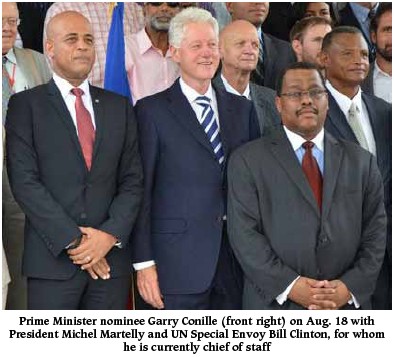
It is a common misconception, both in Haiti and abroad, that the country’s president holds executive power. In fact, his main power is to nominate the man or woman who does: the Prime Minister.
President Michel Martelly, after shunning consultations with the heads of Parliament’s two chambers (as the Constitution demands), saw his first two hard-line nominees – Daniel Gérard Rouzier and Bernard Gousse – rejected by the Parliament, which must ratify the candidate. This stand-off set off alarms in Washington, which saw the President it had shoe-horned into office still floundering without a government over three months after his May 14 inauguration. |
Monday, September 5, 2011
Garry Conille’s Nomination as Prime Minister:Washington puts its foot down!


Sunday, September 4, 2011
Garry Conille’s Nomination as Prime Minister: Washington puts its foot down!
| By Yves Pierre-Louis Haitiliberte | |

After Parliament’s rejection of two prime ministers nominated by President Joseph Michel Martelly, various sectors in Haiti and the so-called "friends of Haiti" began to express their concern about the president’s inability to appoint a successor to the currently resigned Prime Minister, Jean Max Bellerive. Martelly’s outright refusal to negotiate and divvy up government posts with the Parliament’s majority political platform led the country into a political stalemate for more than three months. President Martelly and his team apparently did not understand the principles of power-sharing, and this has opened the door yet again to the meddling of imperialist and neo-colonial foreign powers.
So, on the evening of Wednesday, Aug. 24, six senators from the Senate’s “Group of 16,” controlled by former President René Préval’s Inite party, met with U.S. diplomats led by U.S. Ambassador to Haiti, Kenneth Merten. After that meeting, the Senators would not utter a word to the press. They were apparently holding state secrets to which the Haitian people had no right. |
UN Denied Sex Abuse Before Video Came Out in Haiti, Where New DPKO Chief Ladsous Defended Ouster of Aristide
By Matthew Russell Lee
 UNITED NATIONS, September 3 -- Video depicting UN peacekeepers committing sexual abuse in Haiti has surfaced, two weeks after the UN asked Inner City Press' August 17 questions about the abuse by saying on August 18 that its "investigation was finalized... these allegations were unfounded."
The UN never retracted this denial, or whitewash, even as the cell phone video Inner City Press asked about became public.
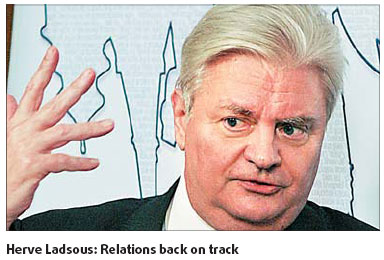
This classic UN cover-up comes at a time when UN Secretary General Ban Ki-moon has just named as the new head of UN Peacekeeping a French bureaucrat, Herve Ladsous, who was a public face of France's call in 2004 for Haiti president Jean-Bertrand Aristide to leave the post to which he was elected.
Saturday, September 3, 2011
Sept. 2, 2011 —U.N. Peacekeepers Accused of Sexually Assaulting Haitian Teen
By ANSEL HERZ, MATTHEW MOSK and RYM MOMTAZ
Alleged Assault Caught on Video, Shows Victim Held Down By Uniformed Men:
Haitians in this remote seaside town are demanding an investigation into allegations that United Nations peacekeeping troops pinned down an 18-year-old Haitian man and subjected him to a humiliating sexual assault.
The alleged assault occurred in July, but graphic cell phone video surfaced in recent days, showing what appears to be the four UN troops in camouflage and some wearing the trademark sky blue berets attacking the man. As the video began circulating through this coastal village, it sparked a growing sense of outrage there and prompted the victim's mother and father to seek criminal charges against the United Nations peacekeeping officers, who are from Uruguay. Both parents submitted written depositions on Wednesday in Port Salut's courthouse.
A medical certificate filed with the court in Haiti and obtained by ABC News, alleges the victim was beaten and had sustained injuries consistent with having been sexually assaulted.
Saturday, August 27, 2011
Wave of Illegal, Violent Evictions Swells in Port au Prince
 |
| Two smiling children in Champs de Mars campin the neighboring of Natitional Palace, Feb.2010. Photo by Wadner Pierre |
First published on HuffingtongPost
Mathias O is 34 years old. He is one of about 600,000 people still homeless from the January 2010 earthquake in Haiti. He lives with his wife and her 2 year old under a homemade shelter made out of several tarps. They sleep on the rocky ground inside. The side tarp walls are reinforced by pieces of cardboard boxes taped together. Candles provide the only inside light at night. There is no running water. No electricity. They live near a canal and suffer from lots of mosquitoes. There are hundreds of families living in tents beside him. This is the third tent community he has lived in since the earthquake.
Monday, August 22, 2011
Martelly Still Unable to Appoint New PM

Published by IPS
PORT-AU-PRINCE, Aug 22, 2011 (IPS) - Almost three months since he was sworn in as the country’s president, Michel J. Martelly has already attempted to appoint two prime ministers to guide his government. Bernard Gousse, a minister of justice under the Gérard Latortue dictatorship (2004-2006) and businessman Daniel Rouzier, were both rejected by Haitian lawmakers.
Rouzier was rejected by lower chamber over technicalities. Gousse was rejected by a group of 16 legislators in the Senate because of his appalling human rights record. Under Gousse, the jails were filled with political prisoners - mostly people from poor neighbourhoods where there was strong support for ousted former President Jean-Bertrand Aristide.
The country is now suffering because there is no prime minister to form a new government to apply the programme of the new president. When he campaigned, Martelly promised to send all Haitian children to school for free. The Haitian people are waiting for him to deliver his promise in September when schools reopen theirs doors.
Sunday, August 21, 2011
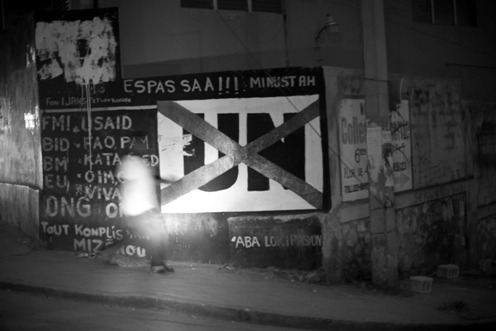
Bye-Bye MINUSTAH!
By Dady Chery.
Published first on Axis of Logic
Monday, Aug 15, 2011
Photograph: Ben Depp
|
| |
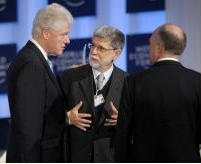
| L-R Bill Clinton, US Envoy to Haiti, Brazilian Defense Minister Celso Amorim and Robert Greenhill, president of the International Canadian Agency for the Development (ACDI) negotiating Haiti's future at Davos. |
Saturday, August 20, 2011
Haiti: Interview with Ambassador of Venezuela to Haiti, Mr. Pedro Gonzalez Canino
 Print This ShareThis
By Lionel Lafortune & Ambassador Canino. Translated for Axis of Logic by Dady Chery
Haiti Progrès. Axis of Logic (Translation)
Wednesday, Jul 20, 2011
Translated from Haiti Progrès for Axis of Logic by Dady Chery*
July 19, 2011
This interview was conducted on the 200th anniversary of the independence of Venezuela. In recent years Venezuela has consistently provided Haiti with invaluable support and obviously has not forgotten the support given to help free herself from the metropolitan power.
Ambassador Canino: I apologize for being unable to see you last week. We were busy with the work of cooperation between Venezuela and Haiti.
Lionel Lafortune (Haiti Progrès): Good morning, Mr. Ambassador. Thank you for seeing us. Please tell us about the 200th anniversary of the independence of the Bolivarian Republic of Venezuela. We know that your country is a true friend of Haiti. How do you see the participation of our ancestors in her liberation?
|
|
This interview was conducted on the 200th anniversary of the independence of Venezuela. In recent years Venezuela has consistently provided Haiti with invaluable support and obviously has not forgotten the support given to help free herself from the metropolitan power.
Ambassador Canino: I apologize for being unable to see you last week. We were busy with the work of cooperation between Venezuela and Haiti.
Lionel Lafortune (Haiti Progrès): Good morning, Mr. Ambassador. Thank you for seeing us. Please tell us about the 200th anniversary of the independence of the Bolivarian Republic of Venezuela. We know that your country is a true friend of Haiti. How do you see the participation of our ancestors in her liberation?
Tuesday, August 16, 2011
Is Haiti's Church Hierarchy Failing in its Mission? Bishop Louis Kébreau’s Immoral Advice to Martelly
era
By Wadner Pierre
Did Catholic Bishop Louis Kébreau, President of the Haitian Episcopal Conference, call on Haitian President Michel Martelly to be ruthless and dictatorial?
That is what many Haitians believe after Kébreau, the only bishop to attend Martelly’s inauguration, urged the president to “put his Sweet Micky pants on” in order to “put Haiti back on track,” in a recent interview with Radio Vision 2000. He later said that he was calling on Martelly to enforce “law and order and discipline.”
“Sweet Micky” was the name of Martelly’s vulgar konpa music persona, whose greatest claim to fame was as the principal cheerleader for Haiti’s bloody 1991 and 2004 coups d’état. “Sweet Micky” defended and celebrated the repression that followed Aristide’s overthrows, during which a combined total of some 8,000 Haitians were killed.
Now President Martelly remains without a Prime Minister because both of his nominees – Daniel Gérard Rouzier and Bernard Honorat Gousse – were staunch defenders of the coups. The Parliament rejected both of them. | |||||

Thursday, August 11, 2011
Brazil Needs to Quit Haiti
 |
| Brazilian occupying troops, march 28, 2011 by Wadner Pierre |
Mark Weisbrot (CEPR.net)
U.S. diplomatic cables now released from Wikileaks make it clearer than ever before that foreign troops occupying Haiti for more than seven years have no legitimate reason to be there; that this is a U.S. occupation, as much as in Iraq or Afghanistan; that it is part of a decades-long U.S. strategy to deny Haitians the right to democracy and self-determination; and that the Latin American governments supplying troops -- including Brazil -- are getting tired of participating.
Monday, July 18, 2011
Pourquoi, Bernard Gousse ne devrait pas être le prochain Premier Ministre d’Haïti
Par: Wadner Pierre
En 2004, j'étais en Haïti vivant l'injustice que Bernard Gousse infligeait à son propre peuple pendant qu’il servait l'élite haïtienne et la «Communauté Internationale». Comme beaucoup de victimes de Gousse, j'étais oblige d’aller vivre dans le marronnage –dans mon cas, il venait après l'arrestation du regretté Père Gérard Jean-Justice, un éminent supporteur de Fanmi Lavalas et militant des droits humains. Sous la dictature de Gérard Latortue, Gousse dirigeait le ministère de la Justice - une machine d’injustice qui était la pour remplir les prisons haïtiennes avec les prisonniers politiques, généralement ciblant les plus vulnérables.
 |
| Bernard Gousse, photo Wadner Pierre 2009 |
Saturday, July 16, 2011
Medics and Lavalas Supporters in Port-au-Prince Celebrate Birthday of Former President Jean-Bertrand Aristide
Photos and article by Wadner Pierre*

Sunday, July 10, 2011
Why Bernard Gousse Shouldn't Be Haiti's Next Prime Minister
By: Wadner Pierre
First publihsed on San Francisoc Bay View
 |
| Photo by Wadner Pierre 2009 |
In 2004, I was in Haiti living under the injustice Bernard Gousse inflicted on his own people while serving the Haitian elite and the "International Community". Like many of Gousse's victims, I was driven into hiding - in my case it came after the arrest of the late Father Gerard Jean-Justice, a prominent Lavalas leader and human rights activist. Under the dictatorship of Gerard Latortue, Gousse ran the Ministry of Justice - an injustice machine that filled Haitian jails with political prisoners, usually targeting the most vulnerable.
Here are seven reasons why Gousse shouldn't be Haiti's next Prime Minister
1) Gousse became the Minister of Justice after the 2004 coup against Haiti's democratically elected President Jean-Bertrand Aristide. Gousse was considered as one of the most powerful men in the U.S-backed regime that ruled from 2004 to 2006. In the 1990s Gousse served in the military dictatorship of Raul Cedras; a regime that used the FRAPH death squads and brutal FAd'H forces to murder people in the slums and countryside.
Thursday, June 30, 2011
Wikileaks: US Embassy Requests Funding for Anti-Chavez Groups
The latest Wikileaks releases include cables sent from the US Embassy in Caracas to the State Department, Central Intelligence Agency, National Security Council, and other US entities, indicating requests for additional US government funding for opposition groups in Venezuela. The cables corroborate documents previously obtained under the US Freedom of Information Act (FOIA) that evidence ongoing US funding to support anti-Chavez groups and political parties in Venezuela actively working to destabilize and overthrow the South American government.
One document dated March 2009, authored by Charge D’Affaires John Caulfield, reveals $10 million in funding via the US Embassy in Caracas to state and municipal opposition governments, as well as several NGOs, youth groups and political campaigns to counter the Chavez government. Curiously, in the confidential cable, Caulfield requests an additional $3 million (on top of an already-approved $7 million) due to a “change” in Venezuela’s “political map”.
Tuesday, June 21, 2011
Enought Is Enough: Haitian People Were Excluded from the 2010-2011 (S)elections
By Wadner Pierre
"Why Haiti's prodigal son, Michel Martelly, may be its savior," is the title of an editorial puff piece published by the Christian Science Monitor (CSM) on June 20, 2001. The piece argues that Haiti's current President Joseph Michel Martelly has the potential to save the country. Unsurprisingly the article ignores not only the background on President Martelly (and more here), but also the illegitimacy of the way in which he was elected, and the ongoing destruction of earthquake camps that his government is helping to facilitate.
During the recent November and April election I visited voting stations across Port-au-Prince, taking hundreds of photographs and speaking with dozens of groups of people. It is because of this experience that I am shocked by the claims made by Metayer. Most bold of his claims is that the recent elections in Haiti brought a "landslide election" victory for Martelly, with 67.6% of the vote.
What Mr. Metayer fails to mention is that in fact Martelly received the support of only 16.7% of registered voters – what CEPR described as "far from a strong mandate – as early reports show Martelly with just 716,986 votes to Manigat’s 336,747." Most of the country decided not to vote.
Tuesday, June 14, 2011
Summer Trip to Haiti: From July 7th to August 7th, 2010

Dear friends and supporters,
For the five years, you have generously supported my work for Haiti both within Haiti’s borders and outside of her borders with your prayers, words of support, and generous donations. On behalf of Haiti and Haitian people, I hope to continue this work and more. I am requesting your support to travel to Haiti from July 7th to August 7th, 2011.
Please note that without your encouragement, financial support, and advice, my work would not have reached such a wide audience, more importantly my people’s voice might not have been heard in different parts of the world. I am so grateful for everything you have done to help me get this job done in a more perfect way. I thank you for your commitment in continuing to be part of Haiti’s endless struggle for social justice and equality.
Sunday, June 5, 2011
NEW WIKILEAKED CABLES REVEAL: HOW WASHINGTON AND BIG OIL FOUGHT PETROCARIBE IN HAITI
by Kim Ives (Haiti Liberte)
René Préval, who passed Haiti’s presidential sash to Joseph Michel Martelly on May 14, was described by U.S. Ambassador to Haiti Janet Sanderson as “Haiti’s indispensable man” in a Jun. 1, 2009 Embassy cable released by WikiLeaks last December.
Sanderson judged him “still moderately popular, and likely the only politician capable of imposing his will on Haiti - if so inclined.” At the same time, “dealing with Préval is a challenge, occasionally frustrating and sometimes rewarding,” she continued. “He is wary of change and suspicious of outsiders, even those who seek his success.”
Préval’s suspicions about “outsiders” seeking his “success” turned out to be justified. In two rounds of presidential and legislative elections held in November and March, Washington aggressively intervened, pushing out of the presidential run-off Jude Célestin, the candidate of Préval’s party Inite (Unity), to replace him with Martelly, a neo-Duvalierist konpa singer who vocally supported the 1991 and 2004 coups d’état against former president Jean-Bertrand Aristide.
Friday, April 29, 2011
Church Fails to Act on Time
By wadner Pierre
 |
| Photo by Darren ell |
As we all know, the Catholic Church in particular has been an instrument for powerful European countries in the past, abandoning its mission to be the voice of the voiceless and to make the poor feel that they belong to the kingdom of God as much as the rich do.
In his Easter Sunday address, the pope urged the world to welcome people who are fleeing their countries because of wars or violence. He said, "May help come from all sides to those fleeing conflict and to refugees from various African countries who have been obliged to leave all that is dear to them."
Monday, March 28, 2011
Haiti's movement from below endures - Features - Al Jazeera English
By Jeb Spragiue- Aljazeera
Despite those in power trying to keep him out, the return of Aristide to Haiti has rekindled hope among the poor.
|

Sunday, March 13, 2011
Return Home: Twenty-One Religious Leaders Extended their Full Support to Former President Jean-Bertrand Aristide on His Return
By Wadner Pierre
March for return, 28 Dec. 2006.Photo by Wadner Pierre


“My time is over. My God is calling me. I ‘m going to die, but make sure ‘Titid’ and his family do not die in exile in South Africa,”
Thus spoke the late Father Gerard Jean-Juste, Haitian activist and the former pastor of Sainte Claire’s Parish of Ti Plas Kazo, a few weeks before his death. He was a champion of democracy and human rights in his country and amongst the Haitian Diaspora. Father Jean-Juste was twice arrested by the de facto regime of Gerard Latortue (2004-2006). The regime was backed by the International Community [especially United States, France and Canada who led the 2004 coup d’état along with the Haitian elite]. The 2004 coup that ousted democratically elected President Aristide forced him to live in exile in South Africa for seven years.
Subscribe to:
Posts (Atom)