Friday, April 29, 2011

Church Fails to Act on Time

By wadner Pierre


wad
Photo by Darren ell
It seems from time to time that the Catholic Church has been deliberately late in addressing the real issues that face God's children on this earth.
As we all know, the Catholic Church in particular has been an instrument for powerful European countries in the past, abandoning its mission to be the voice of the voiceless and to make the poor feel that they belong to the kingdom of God as much as the rich do.
In his Easter Sunday address, the pope urged the world to welcome people who are fleeing their countries because of wars or violence. He said, "May help come from all sides to those fleeing conflict and to refugees from various African countries who have been obliged to leave all that is dear to them."

Monday, March 28, 2011

Haiti's movement from below endures - Features - Al Jazeera English


 By Jeb Spragiue- Aljazeera

Despite those in power trying to keep him out, the return of Aristide to Haiti has rekindled hope among the poor.

One crowd gathers in support of the former president, Jean-Bertand Aristide, now returned from exile[Photo credit: Wadner Pierre]
[Main page photo credit: Wadner Pierre]

Sunday, March 13, 2011

Return Home: Twenty-One Religious Leaders Extended their Full Support to Former President Jean-Bertrand Aristide on His Return


March for return, 28 Dec. 2006.Photo by Wadner Pierre
By Wadner Pierre

“My time is over. My God is calling me. I ‘m going to die, but make sure ‘Titid’ and his family do not die in exile in South Africa,”

Thus spoke the late Father Gerard Jean-Juste, Haitian activist and the former pastor of Sainte Claire’s Parish of Ti Plas Kazo,  a few weeks before his death. He was a champion of democracy and human rights in his country and amongst the Haitian Diaspora. Father Jean-Juste was twice arrested by the de facto regime of Gerard Latortue (2004-2006). The regime was backed by the International Community [especially United States, France and Canada who led the 2004 coup d’état along with the Haitian elite].  The 2004 coup that ousted democratically elected President Aristide forced him to live in exile in South Africa for seven years.

Thursday, March 10, 2011

More on Gran Ravine and Martissant.. The 2005 HNP Report on Lame Ti Manchet and the Involvement of Officers Within HNP Ranks

The follow was published on Jeb Sprague's Blog which can be viewed here:http://jebsprague.blogspot.com/ 

I am releasing here a report that was put together by Haiti's National Police (HNP) on the involvement of some of its officers with Lame Ti Manchèt (the Little Machete Army) during the time of the Latortue interim government in Haiti.  

This report, put together by HNP officials, while acknowledging some culpability on the part of individuals within its force in this specific attack, it says nothing about the wider campaign of constant joint-paramilitary/police operations conducted often throughout much of 2004 and part of 2005  (as a good deal of film evidence and testimonials by witnesses and victims attest).  During these years, following the 2004 coup in Haiti, an unelected interim government worked with sectors of Haiti's elite and security force to constant violent crackdown's on Port-au-Prince's slums- killing, wounding, firing from jobs, imprisoning, and pushing into hiding thousands.  Numerous studies shined a light on this campaign of violence in Cité Soleil (Lawyers Guild, Harvard study, University of Miami Study, Lancet, etc).

In Martissant and Gran Ravine, the communities where Lame Ti Manchèt  was active, the most thorough human rights investigations were conducted by AUMOHD.  Once human rights groups began to build up a campaign against violence in the area, the HNP (and MINUSTAH) were increasingly pressured to reign in the 

Lame Ti Manchèt

.

Rudy Kernizan, a leader of 

Lame Ti Manchèt

, committed suicide when he was surrounded by a PNH squad finally sent in to arrest him.  
  Some say the PNH murdered him.    Most of the 

Lame Ti Manchèt

 have either died/were killed but some are in jail.  Mrs. Kernizan did escape to the DR as I understand it.
   Below is a police report--ordered by Andresol just after he took charge of the PNH,  although Judge Paul Peres let everyone in the police go.  Some believed that Andresol was not honest in backing the report, while others said it was the corrupt (and pro-coup) judiciary that let these people off.  Below is Tom Luce's translation of the report:

Investigative Report: Involvement of the Haitian National Police at St. Bernadette(Martissant) Park August 20, 2005 (Monday, November 6, 2005)

translated by Tom Luce

Note: Although this report is thorough in identifying police involvement in the planning of the operation that resulted in the massacre, and even though it concludes that the police appeared to be passively, if not actively supporting the civilian machete killers, there is no clear culpability assigned other than professional errors and violations of the code of ethics. The only sanctions assigned are reassignments, suspension without pay, and in some cases severance of contracts. The report does conclude that the case should be turned over to the government prosecutor but only specifically mentions the civilian killers.

What judicial proceedings are to arise from this report remain to be seen. Hurah, Inc. and AUMOHD will continue to press for full prosecution of the entire group of people responsible.
At the same time we commend Mr. Mario Andresol, new General Director of the Haitian National Police, for conducting the management of this case in a professional manner. We realize the severe pressure he is under to resign and encourage him to persevere. His fax number: 011-509-245 7374


We are also commending Ms. Dana Banks, Human Rights Office in the U.S. Embassy for supporting a just process. BanksD@state.gov


We renew our request to Mr. Thierry Fagart, UN Human rights officer to support a just process in the case.


We believe all authorities must secure the witnesses, family members, survivors and community members. The families of victims must be allowed to conduct their funerals without further delay. The families must be aided in dealing with the devastation wrought in their lives. Members of the so-called Army of the Little Machete must be apprehended so that further killings will be avoided in the community.


Tom Luce, President of Hurah, Inc.


OBJECTIVE: Involvement of the Haitian National Police at St. Bernadette(Martissant)Park, August 20, 2005

Source: Complaint from the Inspector General's Office


I- The Facts

On Saturday, August 20, 2005, in carrying out legitimate orders some personnel from different units of the Haitian National Police under the Central Administration of the Administrative Police and the Administration of the Department of the West conducted an operation at Martissant intended to question suspected bandits sought after by the police. Some individuals armed with machetes, sticks, and firearms took advantage of the presence of the police to undertake some revenge which ended in the death of a dozen people.


II- The Investigation

1. Following up on some information received from his informants operating in the Martissant zone, the Director of the Department of the West, Division Chief, Carlo LOCHARD, decided to go forward with an operation at St. Bernadette Park located in the said zone where there was taking place as in every year at the same time, a soccer championship.

2. The objective of this operation was to go into the center of said park, to identify, thanks to the presence of informants, the bandits being sought after and to proceed to question them. In fact the information which the Director of the Department of the West had was that a group of individuals were regularly present (whose names were WILGUENS, SASSON, WIDMAILLE, SARDOU) and very involved in different cases of theft, homicide and kidnapping committed in the metropolitan area.

3. The operation was set for Saturday, August 20, 2005 and the Director of the Department of the West organized a briefing with those taking part with their respective teams, the division inspector Jean Michel GASPARD, Agent IV Jean Floran MATHIEU and Agent III Médard BLANCHARD, respectively identified under their code names, DDO-14, DDO-12 and DDO-13. This briefing centered on the plan prepared for the event.

4. After the briefing the Director of the Department of the West contacted by telephone the Central Director of the Administrative Police, Inspector General Renan ETIENNE, to request the reinforcement of specialized units of the Haitian National Police. The Central Director asked him to make contact with the commandants of the units in question while he, from his end, was going to pass on appropriate instructions.

5. On the day set for the operation the units involved (patrols DD0-12, DDO-13 and DDO-14) gathered in the courtyard of the director's office of the Department of the West for last adjustments. At this meeting there were police officers from SWAT Team 3 and the police inspector, Roody PETION, the man in charge of unit MO-13 from the Corps of Intervention and Maintenance of Order. After having received the last instructions from the man in charge of the operation (police officer Jean Floran MATHIEU), the police officers present went on their way to St. Bernadette Park.

6. The teams deployed were formed as follows:

Patrol DD)-12: officers Jean Floran MATHIEU, Niclès DESTIN, Termy HORAT (driver of a Nissan vechile Patrol 1-0676;
Patrol DDO-13: officers Michelet FILS-AIME, Nackel LOUIS, Médard BLANCHARD (driver of the Nissan vehicle Patrol 074;
Patrol DDO-14: officers Grévy LINDOR, Jean Fednel LAFALAISE, Stevenson CLERSAINT, Jean Michel GASPARD (driver of the Toyota Tundra vehicle 1-0837;
Patrol SWAT-3: officers Djuly JEAN_BAPTISTE, Robinson FORTUNATE, Lucksonne JANVIER;
Patrol MO-14: Officers Roody PETION (driver of the vehicle), Jean Avla LAFLEUR, Guilner LINDOR, Gaudy SALOMON, Edgard PASCAL

7. In the course of the trip the patrol of the sub-station of Portail Léogane (composed of officers Pierre Jocelyn LETELIER, Gaby DUCLAIR and Réginald CIVIL, who used a DAIHATSU TERIOS plate number 1-0614) joined the other units and upon arriving at the grounds the drivers received the order to stay at the steering wheels of their vehicles while the deployment was put in place in the following manner:

Group for entering: patrol MO-14 (officers Gaudy SALOMON, Guilner LINDOR, Jean Avia LAFLEUR, Edgard PASCAL) and patrol SWAT-3 (officers Lucksonne JANVIER, Djuly JEAN-BAPTISTE, Robinson FORTUNAT), under the command of the one in charge of the operation, officer A-IV Jean Floran MATHIEU.

Control of the entrance to St. Bernadette Park: patrol DDO-14 (officers Grévy LINDOR, Stevenson CLERSAINT, Jean Fednel LAFALAISE) under the command of the Division Inspector Jean Michel GASPARD.

Control of the intersection of Boulevard Jean Jacques DESSALIINES-Martissant 1: patrol DDO-13 (officers Médard BLANCHARD, Michelet FILS-AIME and Nackell LOUIS).

Control of Prompt St. (behind St. Bernadette Park): patrol Portail Léogane (officers Gaby DUCLAIR, Reginald CIVIL, Pierre Jocelyn LETELIER)

8. Once the deployment was in place the group charged with entering went to the field where the first half-time of the match was finishing. The man named Reginald MICHEL, one of the informants of the Director of the Department of the West for the zone accompanied them to identify the bandits who had to be questioned. The officers opened the main gate and went in to the applause of the crowd, estimated at more than seven thousand people, who believed the officers were there to provided security for the sports event.

9. Officer Jean Floran MATHIEU went to the MC of St. Bernadette Park through whom he ordered the crowd to lie down while the other officers who accompanied him closed the gate at the entry. At that moment a shot rang out which, along with the clanging shut of the gate and the order given by the officer in charge for the crowd to lie down, provoked a panic among those attending the game who rushed toward the exit.

10. Noticing that it was impossible to leave St. Bernadette Park by the main gate, most of the spectators of the game tried to climb the walls surrounding the field while shots were produced in an exchange between the police and the bandits who were trying to cover their flight and to avoid an eventual arraignment.

11. The shots made inside St. Bernadette Park and the garage next to a school classroom "Republic of Peru" resulted in the death of two people: a presumed bandit who exchanged shots with the officers in the group entering the field and the man so-called Réginald MICHEL, beaten by the bandits who identified him as an informant. No mention was made concerning the weapon which the presumed bandit used who was killed in the exchange with the police.

12. At that moment a group of individuals armed with machetes, sticks and firearms took control of the interior of St. Bernadette Park. This group of individuals, known by the name of " Army of Little Machetes" took advantage of the presence of the police to commit attacks of all sorts on the people who were trying to flee.

13. These individuals chased the frightened spectators, mainly those who in their opinion were bandits or who were connected with them and took advantage of the fact that the police did not intervene to stop their actions, killing a certain number of people among whom were: Nesdou FEVRY, Francky HERNE, Denis JEAN-MARIE, Erinel ALCIDAS, Grégory ODICE, Yvens MELISSE and another individual not identified; the names Enock LAPLANTE, Christome DORCE, Jean Milfort PETIT-HOMME and Patrick BAPTISTE were given as those wounded by machete by these individuals.

14. The one in charge of the operation, noting the inability of the police to take control of the situation, requested reinforcements directly by radio and from the Center of Informatiion and Operations (CRO); three patrols were send to the site of the operation:

-Patrol Side Guards: officers Lycon FRANÇOIS, Anderson CHARLOT, Jean René ESPERANCE, Clébert DORLUS;
-Patrol of the Brigade of the Port-au-Prince station: officers Mégène PIERRE, Ronel JEAN, Hielson ANTOINE, Jerôme DESCOMES
-Patrol of the sub-station of Marché Salomon: officers Camélo FRANÇOIS, Harold POPO, Osnel PREVILOR, Dieuriel SAINT-LOUIS

15. These patrols then came to the Martissant zone and took their respective positions:
-in front of the sub station of Martissant on request of the officers stationed at this post;
-at the entry of the fifth avenue Bolosse near the St. Bernadette passageway;
-at the National gas station situated in front of St. Bernadette church.

16. These patrols did not take part in the intervention, being satisfied to control their respective positions until rain put an end to the operation.

17. The officers who had gone into the park, toward the end of the operation, made a tour in the zone situated behind St. Bernadette Park; this permitted them to discover the bodies of two other persons likely killed by machete by members of the small group called "Army of the little Machete". The one in charge of the operation called the ambulance service from the University Hospital of the State of Haiti to transport the bodies.

18. Next, on Sunday, August 21, 2005 some members of the different units of the Haitian National Police carried out, according to the instructions of the General Director of the Administrative Police, a search operation in the zone called Grand-Ravine during which some automatic weapon loaders, ammunition of different caliber and some combat clothes were confiscated.

19. During this operation a Nissan vehicle, "Pathfinder", colored red, found without a license plate was taken and driven to the Headquarters of the Traffic and Road Police.

20. At this time once more members of the little group named "Army of the Little Machete" took advantage of the presence of the police to get involved: no loss of human life was reported but several houses considered the property of bandits were burned.


III- Conclusions of the Investigation

A- The Planning and Execution of the operation of August 20, 2005

1. The operation of Saturday, August 20, 2005 led by the Haitian National Police had been decided upon with the aim of proceeding to question certain presumed bandits whose presence had been pointed out inside St. Bernadette Park.

2. This operation decided upon as a result of information received by the Director of the Department of the West from his informants presents some weaknesses in both its preparation and its execution. In fact:

-No familiarity with the grounds had been obtained; the possibility of an important increase in the number of spectators of the soccer game had not been taken into account which set in motion an inadequate action;
- the identification of the bandits to be questioned was not detailed for the officers participating in the operation but was left in charge of the informants;
- the briefing carried out by officer Jean Floran MATHIEU, responsible for the operation, was not clear; the mission of the different units involved in this mission which had different methods of operating with regard to their specific missions was not made precise;
-the entire group involved in the operation was placed under the command of an officer of Grade A-IV which constitutes a major handicap for the conduct of this operation, the one in charge had neither the capacity nor the necessary rank for an operation of this extent;
-no planning had been done by the Director of the Department of the West in view of answering in an immediate way to an eventual demand for reinforcement given by the people involved in the operation;
- the chief of Port-au-Prince in whose jurisdiction the operation took place had not been informed of its taking place, nor were the officers of the sub-station of Martissant;
-the hearings of the different people in charge did not allow obtaining the motivation for the operation on August 21, 2005 at Grand Ravine

B- The behavior of the officers engaged in the operation.

1. The police who participated in the operation carried out by the Haitian National Police at St. Bernadette Park, particularly those who occupied the soccer field and its principal entrance are responsible to different degrees for the process that led to the events that followed this intervention:

-after having carried out the entrance they ordered the crowd to lie down even though there was no sign, real or apparent, of hostility on their part;
- they locked the principal gate to the field cutting off therefore any orderly exit by the spectators;
-the police responded in an uncontrolled manner to the shots of the bandits and did so without ascertaining the source of these shots thereby increasing the panic reaction of the crowd and consequently increasing the risk of the number of victims;
-the members of the small group called "Army of the Little Machete" carried out their assault, armed with machetes, sticks and firearms, without the police reacting to stop these attacks, but on the contrary with the police openly collaborating or at least passively complicit;
-no measures were taken by the police with a view to bringing assistance to the spectators at the sports event who clearly were in danger.

The combined actions committed by these police entail:
- an illegal act (point 2-03, Punishment Scale, RDG);
- an error against the good name of the police (point 2-21);
- a very serious professional error (point 5-01)
- a violation of articles 7 and 9 of the Code of Ethics of the Haitian National Police;
- a violation of the General Order 003, relative to the use of force.

In addition, in the framework of the investigation pursued by the Inspector General of the Haitian National Police into the events of August 20 at Martissant, the police who participated in the intervention:

-have denied having used their weapons;
- were unaware of the presence and intervention of the individual members of the small group named "Army of the Little Machete";
- deliberately kept silent about the number of dead bodies resulting from this intervention, which constitutes a falsification (point 2-64, Ethics Code: to make a false deposition in an investigation).

C- Action of the Director of the Department of the West with regard to the events of August 20, 2005

1. The division chief, Carlo LOCHARD, Director of the Department of the West, has admitted being the organizer of the operation of August 20, 2005 at St. Bernadette Park for the reasons cited above. However even though he had received the report of police officer Jean Floran MATHIEU, the one responsible for the operation, and having been fully informed of the events that took place subsequent to the so-called intervention, has failed to

-pursue an inquiry into the circumstances which were crucial in these serious events;
-submit a timely report on the specifics to his superiors (General Director of the Haitian National Police, Chief Inspector General)

which constitutes:
-an infraction of orders (points 4-11 and 4-15, Code of Punishments)
-a professional error (point 5-02)

In addition, by making the decision to put back into active service Division Inspector Jean Michel GASPARD-- the same one who, under an investigation undertaken by the Central Administration of the Judiciary Police, was the object of a report of abandoning his post made by of the one in charge of the sub-station of Port-au-Prince (CAFETERIA)- without reporting this to the General Director of the Haitian National Police who had the prerogative, the Division Chief, Carlo LOCHARD betrayed the confidence of his superior (point 2-66, Code of Punishments)

D- The case of the Central Director of the Administrative Police

The Inspector General, Renan ETIENNE, Central Director of the Administrative police admitted in his hearing to having been informed of the intervention by the Director of the Department of the West who had asked him to put at his disposal two patrols of specialized units of the Haitian National Police, namely one from the Corps of Intervention and Maintenance of Order, and the other from the intervention group of the Haitian National Police to which he had responded positively. Nonetheless all the while knowing of the events that took place in the course of the so-called intervention, he failed to:

- undertake an inquiry into the circumstances which were crucial to these serious events
- submit a timely and detailed report to his superiors (Director General of the Haitian National Police, Chief Inspector General)

He also admitted that on Sunday, August 21, 2005 in spite of the grave incidents of the evening before he passed instructions to the commander of the Group of Intervention of the Haitian National Police to the effect that a team of this unit would intervene in the zone of Grand Ravine. This intervention also resulted in important material destruction and no inquiry was made by the Central Director with regard to these events.

Moreover although the Central Director had received a correspondence from the Commander of the GIPNH covering the report of the one in charge of the team which had acted on August 21, 2005 at Grand Ravine, no transmission of said report was made to the Director General of the Haitian National Police, which constitutes:

-an infraction of orders (point 4-11 and 4-15, Code of Punishments)
- a professional error (point 5-02)

E- Members of the small group named "Army of the Little Machete"

1. The information collected in the framework of the inquiry pursued by the office of the Inspector General is that the members of this little group are bandits who had been on a rampage in the zone and who had been chased out after February 2004. They had fled to different places of the metropolitan zone (notably to Bertin, commune of Carrefour) all the while operating in the zone of Bicentenaire under cover as refrigeration technicians.

2. Among those who committed the attacks at St. Bernadette Park and at Grand Ravine there have been identified:

- Frantz LARAME (alias "Gérald Gwo Lombril"), escapee from the National Penitentiary in January 2004
-Jean Yves GEORGES (alis "Brown"), escapee from the National Penitentiary in January 2004;
- Valdimir PADEAU (alias "KIMO") (tried unsuccessfully to gain admission to the Haitian National Police in 2004);
-Guito SAINT-FORT (tried unsuccessfully to gain admission to the Haitian National Police in 2004
- Jean Denis FAUSTIN
-Carlo BERNADEL (alias "CHOUPITE")
- Steve DIEUSIBON (alias "RODNEY")
-Steevenson GEFFRARD (alis "TIAS AKEEM")
-Luckson LOUIS (alias "Girafe")
-Roland TOUSSAINT (the brother-in-law of officer Roody PETION)
-Evens so called (alias "TETE CHANKRE")
-Eddy so called (base La Foi)
-Sweet so called (committed a murder in the Dominican Republic and then escaped from prison to return to Haiti)
-Kikki so called
- Eliphète, so called
- Abdias, so called

IV- Recommendations on the measures to be taken

Consequently the office of the Inspector General of the Haitian National Police recommends:

1. The dismissal of Inspector General Renan ETIENNE, 11-PP-o1557.
2. The dismissal of Division Chief Carlo LOCHARD, 11-PP-02322.
3. The cancellation of the contract between the Haitian National Police and the officers:

-Jean Michel GASPARD, 11-PP-0734, Division Inspector
-Roody PETION, 95-08-07-04205, Police Inspector
-Jean Floran MATHIEU, 99-12-03-05558, A-4
-Guilner LINDOR, 03-14-05-06264, A-1
- Jean Avla LAFLEUR, 03-14-02-05929, A-1
-Gaudy SALOMON, 03-14-03-06123, A-1
-Edgard PASCAL, 03-14-10-06707, A-1
-Lucksonne JANVIER, 11-PP-0o2483, A-2, (DAP)
-Djuly JEAN-BAPTISTE, 02-13-04-05778, A-1
-Robinson FORTUNATE, 95-06-009-02792, A-4
-Nackel LOUIS, 11-PP-0183, A-3
-Stevenson CLERSAINT, 11-PP-0606, A-2

4. A suspension of 60 days with loss of salary for the officers:
-Médard BLANCHARD, 95-04-17-01221, A-3
-Termy HORAT, 99-12-06-05639, A-2
-Michelet FILS-AIME, 03-14-08-06499, A-1
- Jean Fednel LAFALAISE, 04-15-01-06920, A-1
-Niclès DESTIN, 03-14-04-06158, A-1
- Grévy LINDOR, 11-PP-0993, A-3

5. The transmission of the case to the Government Prosecutor
6. The transmission of the case to the Central Director of the Judiciary Police for the pursuit of the inquiry particularly into the matter of the members of the little group named "Army of the Little Machete", identified by the victims.

7. The establishment of a uniform procedure for the conduct of operations in which units under different central administrations will be brought to work together.

Dr. Gessy Cameau Coicou, MD, Inspector General In Chief, MPH

Grand Ravine's Massacre: A Response to Michael Deibert

On Martissant, Gran Ravine, and Missing the Proportionality and Chief Cause of Violence
By: Jeb Sprague
Commemoration of the first anniversary of Gran Ravine's Massacre.The parents and friends of victims of July 27 massacre walked with tears, Jul. 27, 2007. Photo by Wadner Pierre.
The follow was published on Jeb Sprague's Blog which can be viewed here:http://jebsprague.blogspot.com/ 
      The following are my responses to an anonymously posted criticism (on the Haiti Corbet Listserv) of the work of human rights investigators Evel Fanfan (AUMOHD) and Tom Luce (HURAH) who have been highly active in Haiti's slums of Martissant and Gran Ravine since 2005, and, this post is also in response to some of the misleading journalism done  by former Economist Intelligence Unit correspondent Michael Deibert looking at political violence in these communities.

     Michael Deibert has made numerous false claims about myself and many others writing about Haiti in recent years. Links to some of the responses to his absurd claims can be found here: http://wadnerpierre.blogspot.com/2009/08/michael-deibert-and-elizabeth-eames.html
     I would prefer here to discuss the content of this coverage of political violence.
     On the assassination of Jean-Remy Badio, Deibert cites the ACM statement.  This statement says nothing about Lame Ti Manchèt-which according to witnesses, family, friends, and several Haitian media outlets at the time were the primary suspects (and the main force propelling violence in the area).

Sunday, March 6, 2011

Des personnalités de premier plan du mouvement de lutte contre l’Apartheid demandent au gouvernement d’Afrique du Sud d’appuyer le retour immédiat d’Aristide a Haïti


Oakland, Californie – Plusieurs personnalités de premier plan du mouvement international de lutte contre l’Apartheid ont envoyé une lettre ouverte au Président d’Afrique du Sud Jacob Zuma « dans l’espoir que [le Président Zuma puisse] appuyer” le retour de l’ancien président Jean-Bertrand Aristide et sa familla à Haiti « le plus rapidement possible. »  Parmi les signataires de cette lettre figurent le fondateur de Trans Africa Forum ; le révérend Jesse Jackson ; l’acteur et activiste Danny Glover ; le parlementaire britannique John McDonnell ; l’activiste et comique Dick Gregory (qui était une figure de proue du mouvement anti-apartheid en Grande Bretagne), Jack Healy, le fondateur et directeur du Human Rights Action Center (Centre d’Action des Droits Humains), Jack Heyman du Syndicat International des Débardeurs et Magasiniers de San Francisco (lequel a refusé de décharger des navires transportant des produits du régime d’Apartheid d’Afrique du Sud dans les années 80) et Selma James, la veuve du célèbre écrivain C.L.R. James, auteur d’un des livres les plus influents sur la révolution haitienne, Les Jacobins noirs.

Aristide’s Return: 70 year-old Presidential Candidate, Mirlande Manigat Gets it Wrong

By Wadner Pierre
On the left,  Aristide's supporters  asking for his return and the annulment of the last Nov. 28 lections. On the right Presidential candidate Mirlande Manigat's  asking that President Aristide  return after the March 20th elections.


70 year-old presidential candidate Mirlande Manigat seems to confuse human rights and political ambition. The right to return home is one of the basic rights that the former Haiti’s President Jean-Bertrand Aristide and his family have as human beings. This right is an inalienable right. Also, Candidate Manigat seems to forget that her husband Leslie F. Manigat was elected in an election held by the former Haitian military in Jan. 17, 1988 in which less than 10% of the population participated. But that did not deprive Mr. Manigat the right to stay and enjoy life in his country. Why can’t former Haiti’s first-twice democratically elected president return to his home?

Thursday, February 24, 2011

For helping Haiti, thank you, President Zuma

 guardian.co.uk, Thursday 24 February 2011 14.00 GMT 

Haiti is indebted to South Africa for sheltering ousted President Jean-Bertrand Aristide. Please now assist his early return
Jesse Jackson, Danny Glover and others
Jean-Bertrand Aristide (left) being welcomed by South Africa's then president, Thabo Mbeki, on arrival at Johannesburg, in May 2004. South Africa granted Aristide and his family asylum after Haiti's president had been forced into exile by a coup. Photograph: EPA/Jon Hrusa
Dear President Zuma,

We write to offer our warm thanks and appreciation for the gracious generosity and historic hospitality that the South African government and the South African people have offered to President Jean-Bertrand Aristide and his family over the past seven years.
Jean-Bertrand Aristide (left) being welcomed by South Africa's then president, Thabo Mbeki, on arrival at Johannesburg, in May 2004. South Africa granted Aristide and his family asylum after Haiti's president had been forced into exile by a coup. Photograph: EPA/Jon Hrusa
South Africa's action in offering a home to the Aristides, following the coup d'état in 2004, was an act of brotherhood in keeping with the many acts of international solidarity shown towards the people of South Africa during their long walk to freedom. This deed will be remembered by the people of Haiti and the world.

Friday, February 4, 2011

On my return to Haiti …

On my return to Haiti …
By former President, Dr. Jean-Bertrand Aristide
guardian.co.uk, Friday 4 February 2011 20.00 GMT
A profit-driven recovery plan, devised and carried out by outsiders, can not reconstruct my country.

Haiti's devastating earthquake in January last year destroyed up to 5,000 schools and 80% of the country's already weak university infrastructure. The primary school in Port-au-Prince that I attended as a small boy collapsed with more than 200 students inside. The weight of the state nursing school killed 150 future nurses. The state medical school was levelled. The exact number of students, teachers, professors, librarians, researchers, academics and administrators lost during those 65 seconds that irrevocably changed Haiti will never be known. But what we do know is that it cannot end there.

Tuesday, February 1, 2011

Congressional Black Caucus Calls for a New Electionin Haiti

Congressional Black Caucus Task Force on Foreign Policy and International Affairs
Statement on Haiti Elections & OAS Report

Washington, DC – Chairman Emanuel Cleaver, II and Hon. Donald M. Payne, Chair of the Congressional Black Caucus Task Force on Foreign Policy and International Affairs, released the following statement in response to Secretary of State Hillary Clinton’s support of OAS report:

“The Congressional Black Caucus cannot overlook the serious concerns that the recent elections in Haiti have posed to its overall democracy.  The CBC urges the United States and the international community to uphold the ideals of fairness and support a new Haiti election process that is free and fair, respecting the rights of the Haitian people.  

We are not blind to the complexity of this issue, as well as the need for a functional Haitian government.  Our Members have experienced first-hand the denial of voting rights, voter intimidation, and other acts of voter discrimination.  No entity can truly report on the “will of the Haitian” people without accurately counting the unfair circumstances concerning the November elections.  If the United States is going to play a role, public integrity calls for us to do for others what we would do for our own citizens:  equal access and equal protection for those who want to participate in the democratic process. 

Tuesday, January 25, 2011

An Urgent call:Return Former President Jean-bertrand Aristide to haiti

January 23, 2011

Select LanguageAfrikaansAlbanianArabicBelarusianBulgarianCatalanChinese (Simplified)Chinese (Traditional)CroatianCzechDanishDutchEstonianFilipinoFinnishFrenchGalicianGermanGreekHaitian CreoleHebrewHindiHungarianIcelandicIndonesianIrishItalianJapaneseKoreanLatvianLithuanianMacedonianMalayMalteseNorwegianPersianPolishPortugueseRomanianRussianSerbianSlovakSlovenianSpanishSwahiliSwedishThaiTurkishUkrainianVietnameseWelshYiddish

Powered by Translateby Haiti Action Committee

Despite ever-threatening military occupation and police repression, Haitians’ have incessantly demanded the return of President Aristide since he was kidnapped and forced into exile by U.S. Marines in the Feb. 29, 2004, coup d’etat.Haiti Action Committee is honored to post this full-page ad that appeared Sunday, Jan. 23, 2011, in the Miami Herald, echoing the call of Haiti’s democratic movement for the return of President Aristide.

Signed by hundreds of people, it demands that the United States, the United Nations and the Haitian government stop blocking President Aristide from returning to the land of his birth.

The text of the ad and a list of signers appear below.

NYT Promotes Destructive Myths About Aristide


http://www.commondreams.org/view/2011/01/25-7

by Joe Emersberger

Ginger Thompson wrote in the New York Times on January 19 that former Haitian President Jean Bertrand Aristide “rose to power as a champion of Haiti’s poor but became notorious for his violent crackdowns of political dissent.” [1]

The "political dissent" that Thompson refers to is a campaign that included murderous raids into Haiti by rebels comprised of former soldiers and death squad leaders. The rebels were given a safe haven and a base for operations in the Dominican Republic. They were audacious enough to mount an assault on Haiti's National Palace in December of 2001. After a gun battle, they were chased back into the Dominican Republic. The rebels were led by Guy Philippe and Jodel Chamblain, a man responsible for the deaths and torture of thousands of people during Haiti's military rule of 1991-1994 (after the first US backed coup ousted Aristide in 1991). [2]

Saturday, January 22, 2011

A class analysis of Baby Doc

Mothballed playboy dictator recalled to service in Haiti

By Kim Ives
January 20, 2011
This article was first published by Haïti Liberté.
The big question Haitians are asking is: who is behind Jean-Claude “Baby Doc” Duvalier’s surprise arrival in Haiti with an expired Haitian passport on Jan. 16 aboard an Air France flight from Paris? “I have come here to see how I can help my country,” he announced, stepping off the plane.
Yeah, right. It is inconceivable that Baby Doc, 59, would return to the country where there are outstanding criminal proceedings against him without knowing that some powerful foreigners have his back.

Thursday, January 20, 2011

Maxine Waters calls for Haiti's botched elections to be voided and new elections to be held


Washington – Congresswoman Maxine Waters (D-CA) issued the following statement today, marking the one year anniversary of the devastating earthquake in Haiti:

"One year after a catastrophic 7.0 earthquake struck Haiti, the country is still devastated. A million displaced Haitians are still living in tent camps, mountains of rubble are piled in the streets, and billions in assistance pledged by the international community has yet to be delivered. Meanwhile, recent elections have been widely discredited and are unlikely to result in a government capable of leading recovery and development efforts.

So it's with a heavy heart that I issue this statement today because I am very disappointed about the pace of both humanitarian relief and democratic recovery in Haiti, though I remain in awe of the strength and resiliency of the Haitian people.

Wednesday, January 19, 2011

The Return of Former Haiti's Democratically Elected President Jean-Bertrand Aristide Is Crucial for his Health

 by Wadner Pierre
 "The return is indispensable, too, for medical reasons: It is strongly
recommended that I not spend the coming winter in South Africa’s because in 6
years I have undergone 6 eye surgeries.  The surgeons are excellent and very
well skilled, but the unbearable pain experienced in the winter must be avoided
in order to reduce any risk of further complications and blindness," from the letter of President Jean-Bertrand Aristide wrote to describe the state of his health


 One year-and- eight days already passed since a 7.0 magnitude earthquake hit the most important part of Haiti. This horrible earthquake took away over 300, 000 lives, left over 1.5 million homeless and several thousands injured. Ten months after this tragedy a Cholera outbreak discovered. UN is accused. This deadly cholera already sent over a thousand people to death and several thousands to hospital.

Seemingly, the Haiti's former dictator Jean-Claude Duvalier  took advantage of the terrible and inhumane situation, and  chose to return to the country. It was told that Mr. " Baby Dictator" received his diplomatic passport under the defacto regime Boniface Alexandre/Gerard Latortue, a regime fully backed by Washington at that time. Why Mr. Dictator did not make it back in 2005 or whatever the time he received it? Mr. 'Dictator'  brutally ruled the country for 15 years after his father 's death.

The question is, why cannot  former democratically elected President Aristide, a victim of the 2004 coup d'etat obtain his diplomatic passport to return to his country or to go to a country where  he can receive the care he needs for his health? It is a way that the coup organizers and executors use to slowly kill him?  The health of former President Aristide is now a human rights concern. Right to health care is one of the rights that President Aristide has as human. Former President Aristide was forced to leave Haiti. His return should be conditioned. how can a dictator come back to his country,  perhaps, one of his victims cannot?

Mr. Duvalier  left Haiti in 1986 with  millions of dollars and let thousands of people with tears. Now he is in Haiti, the Haiti's justice system made a an important step on January 17th to prosecute him. Haitian people deserve justice, and justice must be given to all victims of the Duvalier's regime.
Meanwhile, President Aristide has been asking for a diplomatic passport for several years. He still cannot obtain it.  President's supporters have been asking for his return since the day after the coup d'etat.  But they have been asking for all coup leaders like Louis Jodel chamblain, Guy Phillipes along with "Mr. Baby Doc' to be take to the court.

The return of President Aristide is today imminent, not only because he legally has  to come back to his homeland,  but also his health condition necessitates this return. He would be shameful to have a democratic President constraints to reserve the care  that his health necessitates  while assassins, murders and criminals are  freed to walk on the streets teasing their victims like nothing had ever happened. "There is reconciliation without justice," said Haitian famous Agronomist Journalist Jean-Leopold Dominique.

Time is come to render justice to the thirty of justice. Time is come to judge the criminals and to send a clear message to those who intend to commit the same criminal acts as did the Duvalier regime.
Haiti has suffering for a long time. Haiti's suffering started back from the day  of its independence. United States, France and Canada along with the Haitian elite, who see only their own economic-interest by destroying the masses, or make them poorer that they had never been before.

   As know on December 16, 1990 Haitian said no to dictatorship and military regimes that ruled this country for a long amount of times. But seven month after the democratically elected President Jean-Bertrand Aristide got into office, a coup ousted him. This Coup d'etat was backed up by United States/ CIA , the Haitian elite and the Haitian former army as the executor of this coup.

Resistance of Haitian people defeated this coup d'etat. on October 15, 1994 "Titid" came back, and he organized democratic elections and  made the first peaceful transitional power in the history of Haiti.
After the celebration of Haiti's hundredth Independence, Another coup d'etat was already on its way. And this this time it was curried by a special US commando. The February 24 coup was the worst political coup  in Haiti's history because it was the time that the country was trying to ride the democratic and economic bus.

In 2006, again people's resistance defeated the coup by electing Preval at the head of the country. President Preval normally has betrayed them. Still, they want to get ride of him in a democratic way, which is inclusive, fair and just elections. But, not the one  OAS, UN, CARICOM cautioned last November 28. Haitian demand for new  fair, just and inclusive elections, not flawed elections. Less than 70% of the Haiti's population went to vote on November 28, 2010.

As many political, economical and sociological experts acknowledge or can argue, progress cannot be made where there is political instabilities, and where  injustice is the rule.

Below is a letter from first former Haiti's democratically elected President Aristide from his exile describing the state of his health. Special thank to Ezili's Haitian Lawyers Leadership Network who shares this letter with us.


Dr  Jean-Bertrand Aristide
Former President of Haiti
19 January 2011

I would like to thank the government and the people of South Africa
for the historic hospitality, deeply rooted in Ubuntu, extended to my family
and I.

Since my forced arrival in the Mother Continent six and a half
years ago, the people of Haiti have never stopped calling for my return to
Haiti.    Despite the enormous challenges that they face in the aftermath of the
deadly January 12, 2010 earthquake, their determination to make the return
happen has increased.

As far as I am concerned, I am ready.  Once again I express my
readiness to leave today, tomorrow, at any time.  The purpose is very clear: To
contribute to serving my Haitian sisters and brothers as a simple citizen in
the field of education.

The return is indispensable, too, for medical reasons: It is strongly
recommended that I not spend the coming winter in South Africa’s because in 6
years I have undergone 6 eye surgeries.  The surgeons are excellent and very
well skilled, but the unbearable pain experienced in the winter must be avoided
in order to reduce any risk of further complications and blindness.

So, to all those asking me to return home, I reiterate my
willingness to leave today, tomorrow, at any time.  Let us hope that the
Haitian and South African governments will enter into communication in order to
make that happen in the next coming days.

United to the Haitian people, once again my family and I express
our sincere gratitude to the government and the people of South Africa.

Monday, January 17, 2011

Human Rights Groups Call for Immediate Arrest of Jean-Claude Duvalier Jan­u­ary 17, 2011-Port-au-Prince and Boston- Today

FOR IMMEDIATE RELEASE
CONTACTS:
Mario Joseph, Av., Bureau des Avocats Internationaux (Port-au-Prince, Haiti),
mario@ijdh.org, 509-3701-9879
Brian Concannon Jr., Esq., Institute for Justice & Democracy in Haiti (Boston, MA), brian@ijdh.org, 541-263-0029
Iran Kurzban, Esq. IJDH Board Chair and attorney in Jean-Juste v. Duvalier, (Miami, FL) ira@kkwtlaw.com, 305-444-0060

Human Rights Groups Call for Immediate Arrest of Jean-Claude Duvalier
Jan­u­ary 17, 2011-Port-au-Prince and Boston- Today, the ­Institute for Jus­tice & Democ­racy in Haiti (IJDH) and the Bureau des Avo­cats Inter­na­tionaux (BAI) call on the Government of the Republic of Haiti to comply with Haitian law and arrest ex-President Jean-Claude Duvalier, who returned to Haiti on a commercial flight yesterday.
IJDH and the BAI note that the extensive legal documentation of Mr. Duvalier’s crimes includes:
·         A July 3, 2009 order from the First Court of Public Law, of the Federal Court of Switzerland, which notes that the Haitian government had informed it of current criminal proceedings against Mr. Duvalier as late as June 2008;
·         The Decision of the U.S. District Court for the Southern District of Florida, Jean-Juste v. Duvalier, No. 86-0459, dated January 8, 1988, finding Mr. Duvalier liable for over $500,000,000  for his misappropriation of public monies for his personal use; and
·         An extensive accounting of Mr. Duvalier’s misappropriation of public funds conducted for the Haitian government by a U.S. accounting firm between 1986 and 1990, establishing the theft of over $300,000,000 U.S.D. of public funds.

Friday, January 14, 2011

One Year After Haiti Earthquake, Corporations Profit While People Suffer

By Jordan Flaherty
Photo by Wadner Pierre
http://mrzine.monthlyreview.org/2011/flaherty120111.html
One year after an earthquake devastated Haiti, much of the promised relief and reconstruction aid has not reached those most in need. In fact, the tragedy has served as an opportunity to further enrich corporate interests.
The details of a recent lawsuit, as reported by Business Week, highlights the ways in which contractors – including some of the same players who profited from Hurricane Katrina-related reconstruction – have continued to use their political connections to gain profits from others' suffering, receiving contacts worth tens of millions of dollars while the Haitian people receive pennies at best. It also demonstrates how charity and development efforts have mirrored and contributed to corporate abuses.
Lewis Lucke, a 27-year veteran of the US Agency for International Development (US AID) was named US special coordinator for relief and reconstruction after the earthquake. He worked this job for a few months, then immediately moved to the private sector, where he could sell his contacts and connections to the highest bidder. He quickly got a $30,000-a-month (plus bonuses) contract with the Haiti Recovery Group (HRG).
HRG had been founded by Ashbritt, Inc., a Florida-based contractor who had received acres of bad press for their post-Katrina contracting. Ashbritt’s partner in HRG is Gilbert Bigio, a wealthy Haitian businessman with close ties to the Israeli military. Bigio made a fortune during the corrupt Duvalier regime, and was a supporter of the right wing coup against Haitian president Aristide.
Although Lucke received $60,000 for two months work, he is suing because he says he is owed an additional $500,000 for the more than 20-million dollars in contracts he helped HRG obtain during that time.
A Symbol of Political Corruption
As Corpwatch has reported, AshBritt “has enjoyed meteoric growth since it won its first big debris removal subcontract from none other than Halliburton, to help clean up after Hurricane Andrew in 1992.” In 1999, the company also faced allegations of double billing for $765,000 from the Broward County, Florida school board for clean-up done in the aftermath of Hurricane Wilma.
Ashbritt CEO Randal Perkins is a major donor to Republican causes, and hired Mississippi Governor Haley Barbour’s firm, as well as former US Army Corp Of Engineers official Mike Parker, as lobbyists. As a reward for his political connections, Ashbritt won 900 million dollars in Post-Katrina contracts, helping them to become a symbol of political corruption in the world of disaster profiteering, even triggering a congressional investigation focusing on their buying of influence. MSNBC reported in early 2006 that criticism of Ashbritt “can be heard in virtually every coastal community between Alabama and Texas.”
The contracts given to Bush cronies like Ashbritt resulted in local and minority-owned companies losing out on reconstruction work. As Multinational Monitor noted shortly after Katrina, “by turning the contracting process over to prime contractors like Ashbritt, the Corps and FEMA have effectively privatized the enforcement of Federal Acquisition Regulations and disaster relief laws such as the Stafford Act, which require contracting officials to prioritize local businesses and give 5 percent of contracts to minority-owned businesses. As a result…early reports suggest that over 90 percent of the $2 billion in initial contracts was awarded to companies based outside of the three primary affected states, and that minority businesses received just 1.5 percent of the first $1.6 billion.”
Alex Dupuy, writing in The Washington Post, reported a similar pattern in Haiti, noting that "of the more than 1,500 US contracts doled out worth $267 million, only 20, worth $4.3 million, have gone to Haitian firms. The rest have gone to US firms, which almost exclusively use US suppliers. Although these foreign contractors employ Haitians, mostly on a cash-for-work basis, the bulk of the money and profits are reinvested in the United States." The same article notes that "less than 10 percent of the $9 billion pledged by foreign donors has been delivered, and not all of that money has been spent. Other than rebuilding the international airport and clearing the principal urban arteries of rubble, no major infrastructure rebuilding - roads, ports, housing, communications - has begun."
The disaster profiteering exemplified by Ashbritt is not just the result of quick decision-making in the midst of a crisis. These contracts are awarded as part of a corporate agenda that sees disaster as an opportunity, and as a tool for furthering policies that would not be possible in other times. Naomi Klein exposed evidence that within 24 hours of the earthquake, the influential right-wing think tank the Heritage Foundation was already laying plans to use the disaster as an attempt at further privatization of the country's economy.
Relief and recovery efforts, led by the US military, have also brought a further militarization of relief and criminalization of survivors. Haiti and Katrina also served as staging grounds for increased involvement of mercenaries in reconstruction efforts. As one Blackwater mercenary told Jeremy Scahill when he visited New Orleans in the days after Katrina, "This is a trend. You're going to see a lot more guys like us in these situations."
And it's not just corporations who have been guilty of profiting from Haitian suffering. A recent report from the Disaster Accountability Project (DAP) describes a "significant lack of transparency in the disaster-relief/aid community," and finds that many relief organizations have left donations for Haiti in their bank accounts, earning interest rather than helping the people of Haiti. DAP director Ben Smilowitz notes that "the fact that nearly half of the donated dollars still sit in the bank accounts of relief and aid groups does not match the urgency of their own fundraising and marketing efforts and donors’ intentions, nor does it covey the urgency of the situation on the ground."
Haitian poet and human rights lawyer Ezili Dantò has written, "Haiti's poverty began with a US/Euro trade embargo after its independence, continued with the Independence Debt to France and ecclesiastical and financial colonialism. Moreover, in more recent times, the uses of US foreign aid, as administered through USAID in Haiti, basically serves to fuel conflicts and covertly promote US corporate interests to the detriment of democracy and Haitian health, liberty, sovereignty, social justice and political freedoms. USAID projects have been at the frontlines of orchestrating undemocratic behavior, bringing underdevelopment, coup d'etat, impunity of the Haitian Oligarchy, indefinite incarceration of dissenters, and destroying Haiti's food sovereignty, essentially promoting famine."
Throughout its history, Haiti has been a victim of many of those who have claimed they are there to help. Until we address this fundamental issue of corporate profiteering masquerading as aid and development, the nation will remain mired in poverty. And future disasters, wherever they occur, will lead to similar injustices.

Jordan Flaherty is a journalist and senior consulting community organizer with the Louisiana Justice Institute. He was the first writer to bring the story of the Jena Six to a national audience, and his award-winning reporting from the Gulf Coast has been featured in a range of outlets including the New York Times, Mother Jones, and Argentina's Clarin newspaper. He has produced news segments for Al-Jazeera, TeleSur, and Democracy Now, and appeared as a guest on CNN Morning, Anderson Cooper 360, and Keep Hope Alive with the Reverend Jesse Jackson. His new book is FLOODLINES: Community and Resistance from Katrina to the Jena Six. He can be reached at neworleans@leftturn.org, and more information about Floodlines can be found at floodlines.org. For speaking engagements, see communityandresistance.wordpress.com.

NEW ORLEANS RESIDENTS: See Jordan Flaherty and Asia Rainey at Maple Street Book Shop on Wednesday, January 19 at 6:00pm. More info: http://www.facebook.com/event.php?eid=192600370755981

US NGO's not-so-charitable

Monday, January 3, 2011

Workers, community converge at Southern Human Rights conference


Published Dec 22, 2010 11:47 PM
Under the theme “From Exclusion to Power,” hundreds of workers and community members gathered in Birmingham, Ala., from Dec. 10 to 12 for the eighth Bi-Annual Southern Human Rights Organizers Conference.

WW photo: Dante Strobino
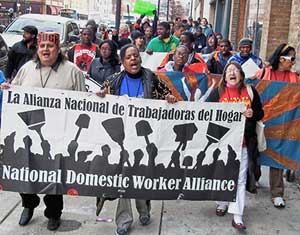
March on opening day of Southern Human Rights Organizers Conference, in Birmingham, Ala. Carrying lead banner are Daniel Castellanos; Pamela Brown, Community Voices Heard; and Araceli Herrera Castillo (left to right).
Jaribu Hill, conference founder and executive director of the Mississippi Workers Center for Human Rights, opened up with a call for human rights and social justice activists from across the country “to retool and rethink, plan and build. In these critical times of unjust wars and economic decline, it is urgent that we forge unity based on common struggles and experiences.”
The gathering opened with a press conference — on International Human Rights Day — that highlighted the work of the Excluded Workers Congress and announced a new report that examines the plight of workers barred from labor protections and the right to organize.
The report said that in 1983, 20.1 percent of the U.S. workforce was unionized, whereas in 2009 that proportion was only 12.3 percent. In so-called right-to-work states, union density now averages 6 percent. (www.excludedworkerscongress.org)
Included in the press conference were the congress’s nine sectors, including domestic workers, farmworkers, taxi drivers, restaurant workers, day laborers, guest workers, workers from right-to-work states, workfare workers and formerly incarcerated workers.
“I came from Peru to work in New Orleans after Hurricane Katrina,” stated Daniel Castellanos, founder of the Alliance of Guest Workers for Dignity, “but my boss told me that I couldn’t organize. But we decided to organize anyway.”
Organizations active in the congress include Domestic Workers United, the National Domestic Worker Alliance, the Coalition of Immokalee Workers, All of Us or None, Community Voices Heard, the Southwest Workers Union, Black Workers for Justice, Alabama Day Laborers and Jobs with Justice. Their members addressed workplace conditions and their fights for recognition, dignity and better wages.
Araceli Herrera Castillo, a 20-year domestic worker from San Antonio, Texas, and SWU and NDWA member, said that they are demanding that the International Labor Organization pass a convention on domestic workers’ rights in June 2011 at their 100th labor congress. “We are demanding our basic rights to be implemented here, like the basic right to organize,” stated Herrera.
Activists marched down Birmingham sidewalks to support domestic worker organizing. They chanted, “Free, Free Domestic Workers! End, End Slavery!” and “!Mujeres marchando, el mundo van cambiando!” They went to the bus terminal, a hub from which domestic workers go “over the mountain” to the suburbs to clean homes and take care of wealthy families.
The Excluded Workers Congress first convened at the U.S. Social Forum in June. Many of its partner organizations gathered for its official founding in September at the AFL-CIO headquarters in Washington, D.C.
The congress is fighting these workers’ exclusion from the National Labor Relations Act, which excludes farmworkers and domestic workers; from the Fair Labor Standards Act, which bars many workers from minimum wage and overtime laws; from the Occupational Safety and Health Act, Civil Rights Act Title VII anti-discrimination protections; and from state labor laws related to the Taft-Hartley Act.
The congress has made gains: Rep. George Miller has agreed to introduce the POWER (Protect Our Workers Against Exploitation and Retaliation) Act in the House of Representatives, and Secretary of Labor Hilda Solis said she would meet with excluded workers. The act was introduced in the Senate in April by Sen. Robert Menendez, among others.
Its supporters say that the law would strengthen workers’ and immigrants’ rights, that it would provide legal protection for workplace organizing, and from immigration enforcement and deportation. It would give workers a way to hold employers accountable. Activists assert that millions of undocumented workers could access their legal rights and would be protected if employers call Immigration and Customs Enforcement. (www.excludedworkerscongress.org)
SHROC provided opportunities for other issues and movements to converge. Workshops and strategy sessions focused on the national fightback to defend education and to end the school-to-prison pipeline. Others discussed expanding the fight for human rights to include environmental justice and health care.
An international panel spoke on U.S. imperialism’s impact around the world. On the Haitian people’s fight for human and democratic rights, Wadner Pierre stated, “You cannot have an election in Haiti without including Fanmi Lavalas,” criticizing the U.S. role there. Fanmi Lavalas, which was banned from participating in Haiti’s recent election, is the party of democratically elected President Jean-Bertrand Aristide, who was ousted in a U.S.-led coup in 2004.
Emria Woods, from Liberia, discussed the negative global role of the U.S. in the fight for human rights. She addressed the struggle in Africa against the U.S. African Command (Africom) and stressed that the U.S. goal there is to secure oil markets. “The fact that 25 percent of U.S. oil now comes from Africa was the leading cause for the establishment of Africom,” stated Woods. Other panelists were Jorge Guerrero Veloz, from the Red Afrovenezolana, and Charo Mina Rojas, from the Black Communities’ Process in Colombia.
Organizers left Birmingham strengthened by the unity at the conference and the fightbacks going on across the South, vowing to move ahead. Organize the South!

Articles copyright 1995-2010 Workers World. Verbatim copying and distribution of this entire article is permitted in any medium without royalty provided this notice is preserved.

Workers World, 55 W. 17 St., NY, NY 10011
Email: ww@workers.org
Subscribe wwnews-subscribe@workersworld.net
Support independent news DONATE